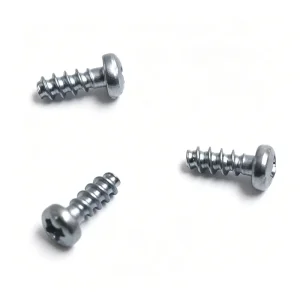
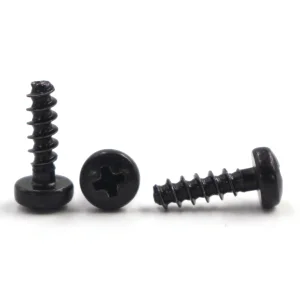
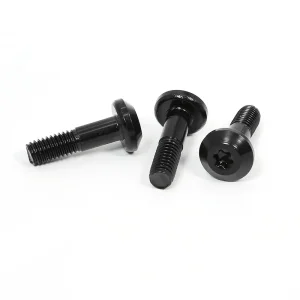
Explore high-tensile, stainless steel, and anti-loosening assemblies manufactured to strict DIN 7981 and OEM cross-recess standards for high-volume automated manufacturing lines.
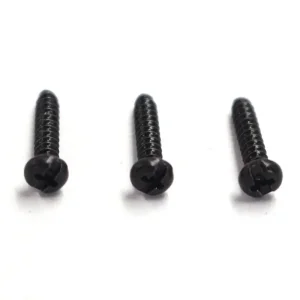
DIN 7981 specifies pan head tapping screws with Phillips (Type H) or Pozidriv (Type Z) drive, and is harmonized with ISO 7049 (which also includes Torx / six-lobe Type 14585). Understanding the precise interplay between point styles, thread pitch, and substrate hardness dictates joint longevity.
Type C (Pointed Cone): Engineered with a tapered conical tip with fully formed running threads down to the lead. It facilitates blind penetration in unthreaded pilot holes in sheet steels up to 2.5mm without runout.
Type F (Blunt/Flat End): Designed for bottoming applications, blind holes in zinc/aluminum die-castings, or thin structural channels where protruding pointed tips risk wire harness abrasion or punctured components.
AISI 1022 / 1022A Carbon Steel: Subjected to carbonitriding or continuous mesh-belt furnace gas carburizing. Surface hardness targets HV 450 min (approx. 45 HRC), while core hardness is tightly maintained at HV 270–390 (28–39 HRC) to prevent brittle fracture under vibrational shear.
A2-70 (AISI 304) & A4-80 (AISI 316): Austenitic stainless steel cold-worked for high tensile capacity without brittleness, offering superior corrosion resistance against halogens, coastal spray, and chemical baths.
Trivalent Galvanizing (Cr3+): Eco-friendly clear, blue, or yellow passivated electroplating offering 96h–168h white rust neutral salt spray protection (DIN EN ISO 9227).
Zinc-Nickel (Zn-Ni 12–15%): Premium automotive coating providing 1000h+ red rust immunity with micro-encapsulated topcoats.
De-Embrittlement Protocol: Immediate baking at 200°C–220°C for 4 to 8 hours within 4 hours of acid-pickling and plating cycles to eliminate interstitial hydrogen traps.
| Nominal Size (ST / Metric) | Thread Diameter (d) Max | Head Diameter (dk) DIN 7981 | Head Height (k) Max | Phillips Cross Drive No. | Torx (ISO 14585) Drive | Pilot Hole Rec. (1.0mm Sheet) |
|---|---|---|---|---|---|---|
| ST 2.2 (No. 2) | 2.24 mm | 4.20 mm | 1.80 mm | PH #1 | T6 | 1.70 – 1.85 mm |
| ST 2.9 (No. 4) | 2.90 mm | 5.60 mm | 2.20 mm | PH #1 | T10 | 2.35 – 2.50 mm |
| ST 3.5 (No. 6) | 3.53 mm | 6.90 mm | 2.60 mm | PH #2 | T15 | 2.85 – 3.00 mm |
| ST 4.2 (No. 8) | 4.22 mm | 8.20 mm | 3.05 mm | PH #2 | T20 | 3.45 – 3.65 mm |
| ST 4.8 (No. 10) | 4.80 mm | 9.50 mm | 3.55 mm | PH #2 | T25 | 4.00 – 4.20 mm |
| ST 5.5 (No. 12) | 5.46 mm | 10.80 mm | 3.95 mm | PH #3 | T25 / T30 | 4.60 – 4.85 mm |
| ST 6.3 (No. 14) | 6.25 mm | 12.50 mm | 4.55 mm | PH #3 | T30 | 5.35 – 5.60 mm |
From automated surface mount electronics to extreme outdoor solar fields, the pan-head profile (DIN 7981) offers wide load-bearing clamping force without countersinking, distributing compressive stress over delicate substrates.
Installed inside automotive door modules, dashboard sub-assemblies, and HVAC climate ducts. OEM automotive assembly lines mandate DIN 7981 with high strip-to-drive torque ratios (typically > 3.5:1), ensuring automated robotic drivers fasten into thermoplastic bosses (ABS, PC-ABS, PP) and aluminum stampings without thread stripping or boss bursting.
In precision telecommunication rack units, high-frequency radar modules, and micro-inverter enclosures, miniature DIN 7981 screws (ST2.2 and ST2.9 in SUS304 / SUS316) provide anti-magnetic stability and zero particulate contamination. Passivated cleanroom-packaged screws eliminate cross-threading risks during repetitive warranty teardowns.
Photovoltaic ground-mount junction boxes, inverter housings, and module frame bonding utilize DIN 7981 A4-70 marine grade or Geomet 500B zinc flake coated carbon steel. Fasteners withstand continuous 50-year UV degradation, temperature cycling from -40°C to +85°C, and galvanic isolation requirements between aluminum frames and galvanized structural brackets.
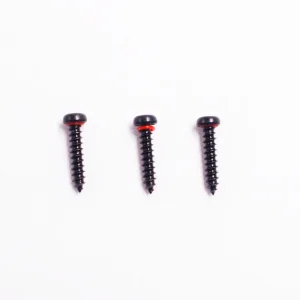
Continuous acoustic vibration and air velocity inside commercial air handling units (AHUs) challenge screw retaining tension. DIN 7981 fasteners integrated with pre-applied micro-encapsulated polyamide (nylon patches) maintain clamp pre-load indefinitely, eliminating vibrational back-out and preventing metal-to-metal fatigue cracking.
Cobot joints, optical encoder covers, and factory floor PLC control panels depend on high-concentricity drive recesses. Six-lobe Torx drive variants of DIN 7981 eliminate cam-out forces, enabling automated feeders to deliver 1.8 Nm fastening cycles with zero recess slippage, extending driving bit lifespan from 8,000 to over 75,000 cycles.
How Yu-Huang Electronics (Dongguan, Shaoguan, Wuhan facilities) leverages an integrated industrial belt ecosystem to compress lead times, stabilize input metal pricing, and eliminate single-source risks.
20,000 m² across Dongguan (precision micro-screws & stamping), Shaoguan (heavy-duty cold heading & heat treating), and Wuhan (automotive & Central China distribution). Workload load-balancing guarantees zero interruption during localized municipal power or environmental checks.
Direct supply contracts with top-tier mills (Baosteel, Xingtai). Raw steel wire rod is verified by spectrometer for carbon, manganese, chromium, and phosphorus fractions prior to cold-drawing, spheroidizing annealing, and phosphating in our own wire preparation shop.
Equipped with internal EDM wire cutting and carbide punch grinding shops. Custom OEM tool sets (modified pan heads, anti-tamper pins, special lead-in chamfers) move from engineering CAD to trial headers within 72 hours, slashing standard 4-week tooling lead times.
By leveraging high-volume wire inventories (over 2,500 metric tons on floor) and long-term supply chain partnerships, we provide global procurement managers with 6-to-12-month fixed pricing contracts, safeguarding margins against steel and currency fluctuations.
Procurement executives must maneuver between DIN and ISO standard conversions, international customs classifications (HS Code 731814), and regional green supply chain accounting standards.
While DIN 7981 remains the most requested blueprint designation across European and Asian engineering offices, the International Organization for Standardization has harmonized this under ISO 7049. Key differences lie in slight head curvature tolerances, recess penetration depth gauges, and the inclusion of Torx (six-lobe) drive designations under ISO 14585. Our dual-stamped production meets both cross-compatibility specs.
Global manufacturers operating assembly hubs in Mexico, Eastern Europe, or Southeast Asia leverage our DDP (Delivered Duty Paid) bonded logistics programs. By supplying consolidated full-container loads (FCL) of mixed C-parts directly into localized vendor-managed inventory (VMI) hubs, buyers avoid port demurrage, minimize customs tariff exposure, and eliminate assembly starvation.
Under Europe’s Carbon Border Adjustment Mechanism (CBAM), carbon embedded in steel hardware imports must be documented. Yu-Huang utilizes electric-arc furnace (EAF) scrap-recycled rod stock where specified and provides verified mill-level Scope 1 and Scope 2 carbon intensity declarations, ensuring total compliance for EU-bound automotive and electrical OEMs.
Engineered to satisfy Tier-1 automotive APQP standards, PPAP Level 3 documentation, and strict international environmental chemical directives.
Complete Production Part Approval Process packages including Design FMEA, Process Flow Diagrams, Process FMEA, Control Plans, Gage R&R studies, and Full Dimensional Layout inspection. International Material Data System (IMDS) entry ensures full transparency into automotive global platforms.
Every shipment is certified free of hazardous substances under EU RoHS 2011/65/EU and REACH Annex XVII SVHCs. Heavy metals (Lead, Mercury, Hexavalent Chromium, Cadmium) and phthalates are banned via strict laboratory ICP-OES validation. Full Dodd-Frank Section 1502 3TG conflict minerals reporting provided.
Equipped with Mitutoyo optical comparators, Fischer X-Ray fluorescence plating thickness testers, Vickers micro-hardness testers, torsion testing fixtures, and continuous cyclic corrosion salt spray chambers. 100% of automotive-bound fastener lots run through high-speed glass disk optical sorting machines.
Discover how Yu-Huang engineers are addressing emerging industrial challenges—lightweighting, automated robotic screwdriving, and zero-defect requirements in high-stress assemblies.
Shifting from traditional round-shank DIN 7981 to trilobular thread geometry (DIN 7500 / Taptite compatible) to reduce thread-forming torque by 30%, eliminate tapping swarf, and provide 100% resistance to vibrational loosening without lock washers.
Replacing traditional liquid sealers with nano-composite zinc flake and water-based inorganic protective coatings. Achieving electrical bonding (EMI shielding) across mating components while maintaining 1,500 hours neutral salt spray resistance without hydrogen embrittlement risks.
Equipping high-speed progressive cold-headers with acoustic emission sensors and piezoelectric force monitors that detect micro-cracks, tool chipping, and head eccentricities at 350 strokes per minute, aborting defective cycles before batches are contaminated.
Transitioning heading and rolling oil systems to bio-based vegetable cutting coolants with closed-loop centrifugal oil recycling. Reducing manufacturing footprint by 28% and ensuring clean, oil-free surface finishes ready for automated vacuum feed assembly.
Our senior fastener applications engineering desk reviews standard and non-standard DIN 7981 configurations, pilot hole sizing, plating compatibility, and finite element assembly simulations within 24 hours.
Direct, unambiguous answers concerning tolerances, material selections, pilot hole drilling calculations, and international shipping protocols.
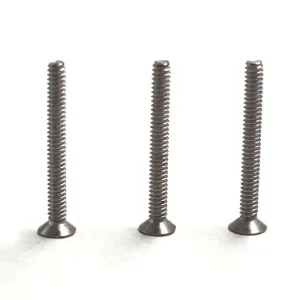
All three standards describe cross-recessed self-tapping screws for sheet metal, but their head geometries differ completely: DIN 7981 features a Pan Head (cylindrical side profile with rounded top) that sits flush against flat surfaces to provide high under-head clamping load without countersinking. DIN 7982 is a Countersunk Flat Head designed to sit entirely flush within a conical hole. DIN 7983 is an Oval (Raised Countersunk) Head combining a countersunk base with an aesthetic curved top cap.
Because DIN 7981 carbon steel tapping screws require a surface hardness ≥ 450 HV to tap through structural sheets, the steel matrix is susceptible to atomic hydrogen absorption during electro-cleaning, acid pickling, and electroplating. If trapped hydrogen migrates to stress concentration zones under preload, delayed catastrophic brittle fracture can occur hours or days after assembly. We mitigate this through controlled low-acid cleaning, immediate post-plating thermal de-embrittlement baking at 200°C–220°C for 4–8 hours, and non-electrolytic zinc-flake alternatives (Geomet / Dacromet).
Pilot hole size is directly dictated by sheet metal tensile strength and thickness. As a general engineering formula for steel sheets between 0.8mm and 2.0mm, the pilot hole diameter should approximate 80% to 85% of the screw's nominal outside thread diameter. If the hole is too small, driving torque spikes, risking screw head shearing or stripped driver bits; if the hole is too large, the engaged thread crests will fail under tension, stripping the thread. Refer to our engineering matrix above or request our pilot hole calculation guide for aluminum and molded plastic bosses.
Standard austenitic stainless steel (A2-70 / A4-70) cannot be case-hardened through thermal carburizing because heating destroys the chromium passivation layer. Therefore, A2/A4 stainless tapping screws are only suitable for tapping into softer substrates like aluminum, brass, or plastics, or into pre-threaded thin sheet metal. When tapping into steel or stainless sheet, engineers must specify Martensitic C410 hardened stainless steel or bimetal screws (austenitic body friction-welded to a hardened carbon steel tapping point).
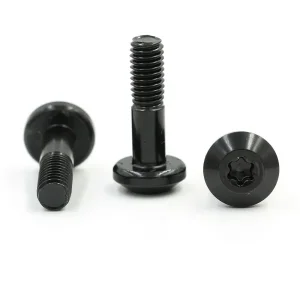
The standard DIN 7981 specifies Phillips (Type H) or Pozidriv (Type Z) cross recesses. While Phillips is widely accessible in maintenance environments, it inherently exhibits cam-out forces at higher torques. For automated robotic assembly lines and zero-slip requirements, we strongly recommend Torx (Six-Lobe / ISO 14585) drive. Torx drive enables 100% torque transmission with zero cam-out, prolonging driver bit lifecycles and eliminating metal sliver contamination inside electronic assemblies.
For standard catalog metric sizes with zinc plating, standard lead times are 7–10 days. For custom modifications (special drive recesses, under-head sealing gaskets, custom length/diameter steps, or specialized plating like Zinc-Nickel), initial tooling samples require 7–10 working days, and mass production runs 20–25 days. Minimum order quantities typically start at 50,000 to 100,000 pieces depending on wire gauge, with buffer stock warehousing available for scheduled blanket releases.
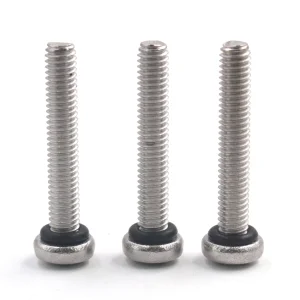
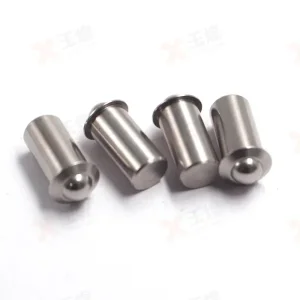
Discover specialized fasteners manufactured under the same zero-defect quality architecture—from Torx sockets and PCB hardware to spring-loaded ball plungers and weather-sealed assemblies.