Engineered cold-headed and CNC-machined components designed for micro-tolerances, shear structural stability, and extreme industrial reliability.
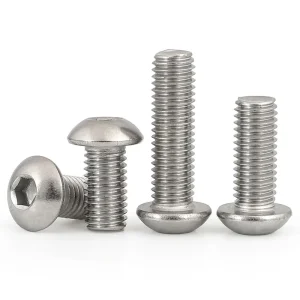
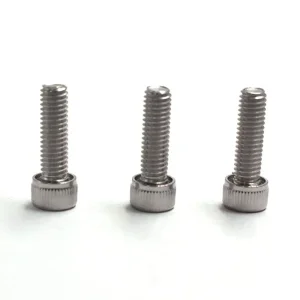
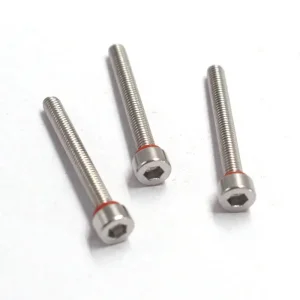
Why precision shoulder bolts (stripper bolts) are transitioning from basic mechanical hardware to mission-critical alignment elements across global multi-axis assemblies.
In modern industrial design, mechanical joints are increasingly subjected to non-linear dynamic stress profiles, multi-directional shear vectors, and continuous high-frequency oscillations. While standard threaded machine screws are engineered primarily to generate axial clamping force (preload) to resist separation along the fastener axis, they perform poorly under severe transverse shear loads. Applying sustained shear forces against threaded sections inevitably leads to stress concentration in root threads, fatigue cracking, and micro-fretting.
This is where precision shoulder screws (also widely classified as stripper bolts or shoulder bolts) fulfill a critical, dual-function structural role. Characterized by an oversized, precision-ground cylindrical shank positioned between the drive head and a smaller threaded terminal, a shoulder screw acts simultaneously as an ultra-stiff dowel pin and a secure threaded anchor. The ground shoulder bears high transverse shear, provides a perfectly concentric journal surface for rotating components, or establishes an exact mechanical stop for floating, spring-loaded subassemblies.
Provides an h7/h8 precision-ground surface that eliminates inner-race play on pulleys, linkage arms, cam rollers, and dynamic hinges without requiring separate bronze bushings.
Indispensable in progressive metal stamping dies, spring-loaded ejector pins, and mold assemblies to guarantee consistent stroke limit and zero galling across millions of cycles.
Prevents structural deformation in fragile multi-layer PCB enclosures, automotive ECU casings, and carbon-fiber composite panels by transferring clamping torque to the shoulder face.
From the manufacturer’s viewpoint, cold forming and thread rolling a shoulder screw require fundamentally different process controls than standard machine screws. The concentricity between the unthreaded shoulder diameter and the threaded pitch diameter must be maintained within ≤0.02 mm (20 microns), and shoulder runout relative to the head seating plane must not exceed 0.015 mm. In high-speed pick-and-place robotics or aerospace avionics, any dimensional deviation triggers mechanical binding, micro-vibrations, or catastrophic joint shear failure.
Navigating global procurement volatility, multi-jurisdictional environmental directives, and technical material compliance.
Seamless interchangeability across ISO 7379, DIN 923, ASME B18.3.3M, and JIS B1198. Precise thread relief undercuts eliminate galling against female tapped blind holes.
Full spectrum chemical safety. Every surface coating—from trivalent zinc passivations (hexavalent chromium-free) to electroless nickel and black oxide—is fully compliant.
Full APQP documentation, IMDS submissions, FMEA risk mitigation, and Level 3 PPAP verification packages for automotive Tier-1 OEMs worldwide.
Complete traceability from certified raw steel wire rod (AISI 304/316, 4140 alloy, SCM435, brass) down to the final heat-treatment lot with 3.1 EN 10204 inspection certificates.
Combining multi-station cold heading high-speed throughput with secondary CNC Swiss machining centers.
| Dimensional & Mechanical Parameter | Cold Heading Process Limits | Secondary Precision CNC Swiss Turning | Centerless Precision Grinding |
|---|---|---|---|
| Shoulder Diameter Range (Ø) | Ø 2.0 mm – Ø 20.0 mm | Ø 1.0 mm – Ø 32.0 mm | Ø 1.5 mm – Ø 25.0 mm |
| Shoulder Length Capability (L) | Up to 120 mm | Up to 250 mm | Up to 300 mm |
| Diameter Tolerance Class | ISO h9 / h10 (±0.025 mm) | ISO h7 / h8 (±0.012 mm) | ISO h6 / h5 (±0.004 mm) |
| Surface Roughness (Ra) | Ra 0.8 – 1.6 μm | Ra 0.4 – 0.8 μm | Ra 0.1 – 0.2 μm (Mirror-finished) |
| Concentricity / Runout | ≤ 0.05 mm TIR | ≤ 0.02 mm TIR | ≤ 0.005 mm TIR |
Cross-industry deployments where custom shoulder screws deliver decisive technical reliability.
Fabricated using passivated 316L stainless steel or titanium alloys with surface electropolishing. Shoulder bolts function as ultra-low particle generation fulcrums inside wafer-handling mechanical grippers and vacuum chambers.
Shoulder bolts act as high-strength grounding pins and busbar spacers. Class 10.9 and 12.9 heat-treated alloy steel delivers massive shear resistance against vehicle chassis shock pulses.
Commonly referred to as stripper bolts in tool and die rooms, these components absorb violent reciprocating rebound shocks in stamping dies, guiding stripper plates with absolute parallel accuracy.
Next-generation developments in metallurgical engineering, surface tribology, and Industry 4.0 automation.
Applying Diamond-Like Carbon (DLC) and PVD coatings directly to the shoulder journal reduces friction coefficients to <0.08, completely eliminating the need for liquid lubrication in medical automation and aerospace assemblies.
Moving from conventional multi-cut turning to progressive 6-station near-net-shape cold forging followed by high-speed CNC finish rolling. This preserves unbroken metallurgical grain flow, lifting fatigue life by over 40%.
Integrating 360-degree high-definition optical triangulation sensors directly into header output chutes. Every manufactured shoulder is measured for diameter, ovality, and pitch concentricity at 800 parts per minute.
Authoritative technical answers to questions commonly raised by mechanical engineers, tool designers, and industrial sourcing managers.
A dowel pin is an unthreaded, press-fit alignment cylinder that absorbs shear forces but offers no axial retention capability. A shoulder screw provides a precision-ground unthreaded shoulder that serves the identical shear or journal function as a dowel pin, but adds a threaded end and head flange for reliable axial clamping, variable standoff positioning, or mechanical fastening without requiring high press-fit installation tonnages.
Tightening torque must always be calculated based on the threaded diameter, not the shoulder diameter. Furthermore, mechanical preload stops immediately once the shoulder seat contacts the mating substrate surface. Exceeding nominal torque on the thread neck without a proper undercut will shear the screw at the shoulder-thread transition plane.
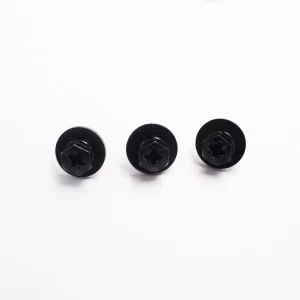
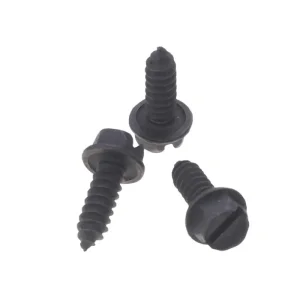
Yes. Our multi-station heading equipment and CNC Swiss cells produce custom drive recesses including standard Hexagon Socket, Torx (six-lobe), Torx Plus, Security Tamper-Resistant Pins, Low-profile Splines, and Slotted Pan Heads. We regularly process 303, 304, 316 Stainless Steels, 4140, SCM435, Brass, Titanium Gr2/Gr5, and Aluminum 7075.
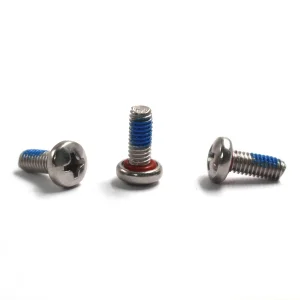
Because the shoulder shoulder face seats directly against the mating fixture, mechanical lock washers cannot be placed under the screw head. Instead, we offer pre-applied blue, yellow, or red prevailing-torque nylon patches (MIL-DTL-18240 compliant) or 360-degree microencapsulated chemical adhesives (such as Loctite/Dri-Loc equivalents) applied directly to the male threads.
ISO 7379 specifies an h8 tolerance on ground shoulders for standard commercial stock, with f9 or h7 available upon technical agreement. For demanding automated machinery, our specialized secondary centerless grinding lines produce h6 tolerance grades (down to ±0.004 mm on diameter) with surface finishes finer than Ra 0.2 μm.
Engineered cold-formed fasteners, sealing combinations, and non-standard industrial components for automotive, consumer electronics, and machinery applications.