Explore high-tolerance metric thread solutions engineered for automated optical sorting lines, vibration resistance, and specialized mating substrates.
Fasteners represent the unsung foundation of physical civilization. Modern mechanical assembly is experiencing an epochal transition from simple mass-market commodity fasteners to safety-critical, high-stress, engineered micro-components.
Tier-1 industrial operations have moved decisively beyond volatile localized sourcing. Advanced manufacturing bases in Dongguan integrate wire rod annealing, pickling, progressive cold heading, precision thread rolling, and electrolytic plating in synchronized local ecosystems to mitigate geopolitical bottlenecks.
Electric vehicles present severe engineering hurdles: extreme battery pack vibration, high electromagnetic interference, and dielectric isolation demands. Mechanical fasteners now function simultaneously as ground points, structural seals, and high-frequency anti-vibration nodes.
The proliferation of wearable medical diagnostics, folding optical devices, and 5G transceiver arrays necessitates thread geometries down to M0.8. Maintaining structural tensile capacity while rolling flawless thread flanks requires sub-micron carbide tooling matrices.
Modern fastener manufacturing has shifted from purely empirical metallurgical stamping to multi-physics computational simulation and closed-loop process automation.
Prior to tool strike, blank deformation is calculated via explicit nonlinear FEA. Cold-heading dies are contoured to ensure metal crystalline flow lines remain uninterrupted through the critical head-to-shank junction, vastly increasing fatigue longevity over cut components.
Precision planetary and flat die rollers induce cold-work deformation across the raw root circumference. Work hardening increases root compressive yield capacity by 20-30%, eliminating tensile micro-cracks typical of chip-forming lathe turnings.
Laser dimensional triangulation sensors cross-reference 360-degree profile metrics at rates surpassing 800 parts per minute. Integrated eddy-current sorting arrays verify structural core heat-treatment phase compliance, delivering genuine single-digit PPM consistency.
Different engineering sectors impose entirely distinct stress parameters. Our cold-forming lines configure fasteners around exact physical environment limits.
| Sector Domain | Predominant Failure Modes | Material & Treatment Vector | Proprietary Fastener Geometry |
|---|---|---|---|
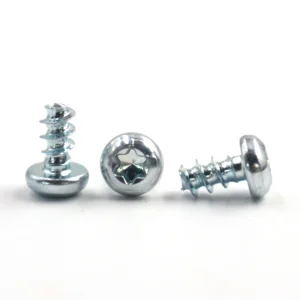
| Consumer & Industrial Electronics | Stripping boss plastic threads, galling, assembly driver cam-out. | Austenitic 304/316 Stainless, Passivated, Eco-Zinc Plating. | PT-Thread Profiling (30° profile angle) with deep Phillips/Torx drive recesses. |
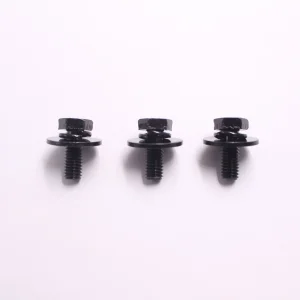
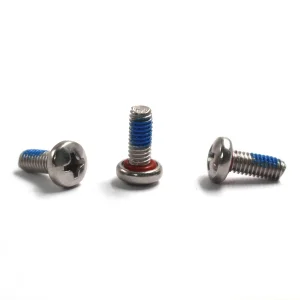
| Automotive Powertrain & Chassis | Transverse vibration loosening, cyclic shear fatigue, thermal shock. | Alloy Steel Grade 8.8, 10.9, 12.9; Quenched & Tempered, Zinc-Flake. | Integrated SEMS spring/flat washers, micro-encapsulated chemical patches. |
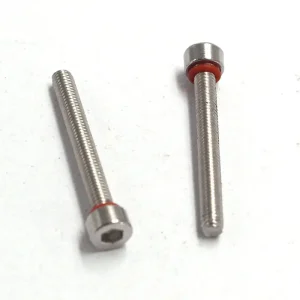
| Sealed Enclosures & Outdoor Nodes | Galvanic degradation, gas/fluid seepage along internal thread helix. | A2-70, A4-80 Stainless Steel, Dacromet, Fluoropolymer barrier coats. | Engineered under-head O-ring seating grooves forming hermetic IP67/IP68 seals. |
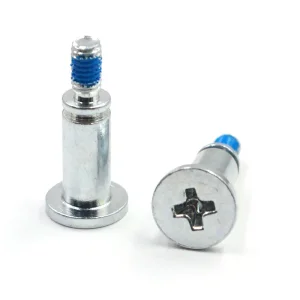
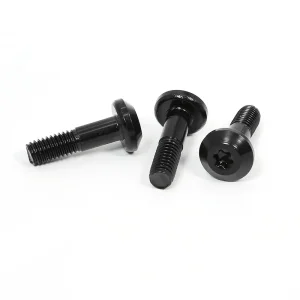
| Precision Automation & Jigs | Axial dislocation, pivot-point mechanical wear, setting drift. | High Carbon Chromium Steel, Case Hardened, Black Oxide. | Ground-diameter shoulder screws with micro-pitch retention and anti-loosening threading. |
An unyielding commitment to reliability requires rigorous gates across our production plants in Dongguan, Shaoguan, and Wuhan.
Every incoming batch of alloy wire rod is subjected to Spark Optical Emission Spectroscopy to verify trace metallurgy. Grain size, tensile strength, and spheroidized annealing quality are logged into ERP lot registries for multi-year tracking.
High-strength carbon fasteners (Class 10.9 and above) undergo de-embrittlement baking within four hours of acid pickling or electroplating. Calibrated thermal soak furnaces bake items at 200°C–230°C to evacuate atomic hydrogen and protect against delayed brittle fracture under preload.
Controlling torque-tension scatter requires precision coefficient-of-friction management. Applied torque sealants, waxes, and micro-encapsulated coatings are monitored via automated torque test rigs to ensure repeatable tension yields across robotic assembly lines.
Explore further standard and custom hardware catalog items, from waterproof rubber O-ring sealing systems to DIN 7982 countersunk screws.
Direct, highly-detailed technical responses addressing dimensional engineering, metallurgical choice, and cross-border manufacturing logistics.
