
Direct from cold-heading lines to international assembly hubs. Fully traceable and tested to IATF 16949 / ISO 9001 criteria.
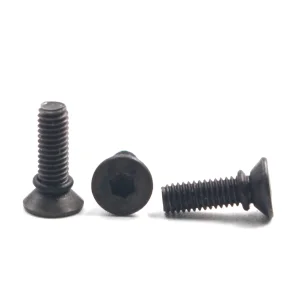
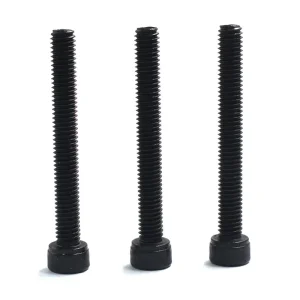
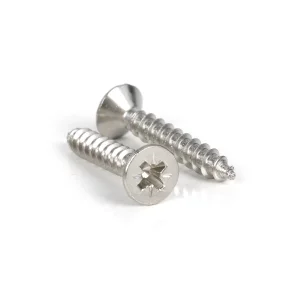
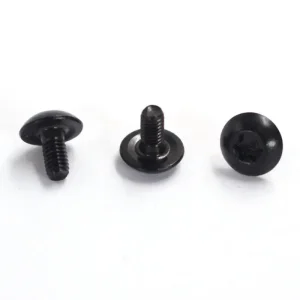
In high-reliability industrial assembly, the fastener is rarely a single passive component; it is an engineered clamping system. A SEMS screw (originating from "The Screw and Engineering Machine Attachment" process) is an integrated, pre-assembled combination fastener featuring one or more captive washers. Unlike conventional loose screw and washer pairings—which require manual or multi-step pick-and-place alignment—the washer on a SEMS screw is slipped onto the blank prior to the thread-rolling operation. During precision thread rolling, the major thread diameter (Dmaj) expands outward, becoming larger than the inner diameter (din) of the washer. This traps the washer under the screw head permanently while leaving it free to spin freely and seat evenly.
This architectural difference is profound. In mission-critical applications—such as automotive electrical chassis grounding, electric vehicle (EV) battery disconnect units, photovoltaic inverters, and high-frequency vibration machinery—loose washers represent latent failure modes. Assembly operators or robotic pickers can drop loose washers into active stator coils or internal PCB logic boards, causing immediate short-circuits. Furthermore, inconsistent manual seating of split-ring spring washers causes erratic clamp-force distributions. SEMS assemblies eliminate washer omission errors, guarantee exact metallurgical pairing, and streamline automated manufacturing cycles by up to 35%.
The torque-tension equation (T = K × D × F) dictates that the torque coefficient (K) is highly dependent on under-head bearing friction (μb) and thread pitch friction (μth). In loose screw-washer systems, operators encounter variable frictional interfaces: between the screw head and the washer, and between the washer and the mating substrate. SEMS technology provides predictable contact geometry. The free-spinning captive washer absorbs rotational friction during final torque application, converting more applied rotary energy directly into axial clamping preload (Fpreload) rather than losing it to torsional shear or surface galling on sensitive substrates such as powder-coated aluminium or magnesium casings.
Evaluating macroeconomic pressures, automated throughput targets, and the shift away from loose fasteners across global manufacturing hubs.
Procurement teams increasingly realize that fastener unit cost accounts for less than 15% of the total installed assembly cost. Sourcing SEMS screws eliminates double-SKU handling, separate washer inventory, split-order freight tariffs, and downstream rework costs associated with missing washers.
Modern assembly lines using automatic blow-feed or vacuum-assisted screwdrivers cannot process loose washers without severe jamming. SEMS fasteners feature exact shank-to-washer coaxial tolerances, preventing track jams and facilitating seamless robotic insertion at speeds over 60 cycles/min.
The global push toward EV battery packs and utility energy storage requires dual-washer SEMS (conical Belleville + flat washer) capable of absorbing continuous thermal cycling and road shock while maintaining gas-tight electrical grounding contacts.
How advanced cold-heading automation, optical sorting, and distributed regional facilities guarantee zero-defect delivery worldwide.
Spanning over 20,000 m² across advanced industrial clusters in Dongguan, Shaoguan, and Wuhan, our manufacturing ecosystem embodies smart Industry 4.0 standards. Operating multi-station cold-heading equipment integrated with automated washer-collating feeder stations, high-speed thread rollers, and continuous atmospheric heat-treatment furnaces ensures complete vertical control.
By controlling incoming wire rod verification (spectrum chemical analysis), grain flow cold-forming, cryogenic deburring, captive assembly, and multi-stage electroplating in-house, we eliminate external subcontracting delays and deliver unmatched batch-to-batch metallurgical stability.
Automated high-speed production demands strict PPM (parts per million) quality metrics. Our facilities utilize AI-driven laser and high-resolution glass-plate optical sorting systems to inspect every single fastener for:
| Performance Dimension | Loose Screw & Washer Sets | YH Fastener SEMS Technology | Engineering Benefit |
|---|---|---|---|
| Line Assembly Speed | 12–18 units / min (manual or complex dual-feeder) | 40–65 units / min (continuous automated blow-feed) | Up to 300% throughput increase on automated assembly cells. |
| Assembly Error Rate | 0.5% – 2.0% (omitted, reversed, or doubled washers) | 0.0001% (Zero washer defect rate via capture) | Complete prevention of electrical shorts and structural recalls. |
| Inventory SKU Management | 2–3 individual SKUs per joint (Screw + Split + Flat) | Single unified part number (Integrated SEMS) | Simplifies ERP, warehousing, purchasing, and bin stocking. |
| Preload Consistency | Erratic due to varying contact interface friction | Predictable torque-to-tension conversion | Guarantees clamp retention under sustained dynamic vibrations. |
Engineered to meet specific mechanical load, vibration absorption, and surface grounding requirements.
Distributes tensile load across ductile or soft materials (plastics, zinc die-castings, copper busbars), preventing surface indentation, micro-cracking, and localized galvanic stress.
Maintains constant axial tension on threaded joints subjected to thermal expansion differentials or cyclic vibrations, resisting rotational self-loosening.
Internal or external teeth bite through anodized layers, paint, or passivation films to ensure low-resistance electrical grounding contact in power supply and telecom enclosures.
Delivers exceptionally high spring energy in compact spaces. Ideal for busbar joints and heavy EV power electronics where severe expansion cycles occur without loss of joint preload.
Proven reliability across stringent automotive, renewable infrastructure, and computing hardware applications.
SEMS screws featuring captive external tooth or conical spring washers provide permanent structural retention in high-vibration inverter housings. Captive design prevents dropped loose hardware from causing high-voltage shorts across lithium-ion battery modules.
High-density rackmount chassis require rapid field servicing and vibration-proof fan mounting. Pan-head SEMS fasteners with integral nylon or smooth flat captive washers safeguard delicate PCB substrates and shield server enclosures against harmonic vibration loosening.
Outdoor micro-inverters and balance-of-system panels face severe diurnal thermal expansion and corrosion. Passivated 304/316 stainless steel SEMS screws resist coastal salt spray and preserve torque retention over 25-year service lifetimes.
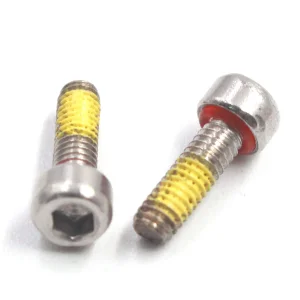
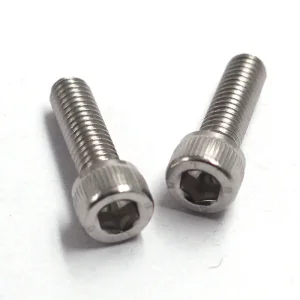
Explore our complementary fastening range designed for harsh environments and precision mechanical alignment.
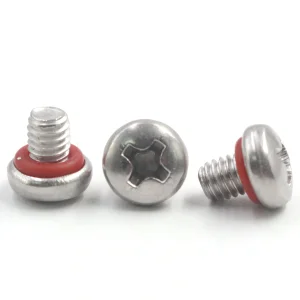
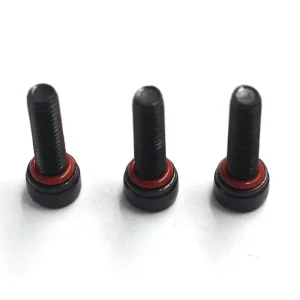
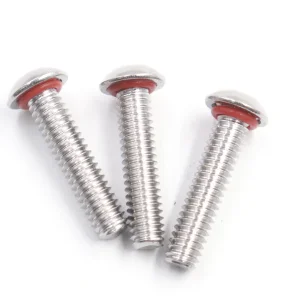
In-depth technical answers addressing manufacturing feasibility, torque specifications, and customization parameters.
The manufacturing process sequences the washer placement before cold thread rolling. First, the screw blank is headed with a smooth shank diameter that is slightly smaller than the washer's inner hole. The washer is automatically fed onto the blank shank. Then, the blank passes through high-precision flat or cylindrical thread-rolling dies. The thread-rolling process plastically displaces metal, creating threads whose crest (major diameter) is significantly larger than the washer's inner diameter. The washer remains completely captive for the lifetime of the fastener, able to spin freely on the unthreaded under-head neck without coming off.
Yes. Dual-washer SEMS screws are widely utilized across automotive and heavy machinery. A common combination is a helical split-lock washer paired with a wide flat washer (or a Belleville spring washer combined with a flat washer). The flat washer protects delicate surface coatings from being scored or abraded, while the spring or Belleville component maintains active axial preload under continuous shock or thermal expansion cycles.
We manufacture SEMS screws in carbon steel (Grade 4.8, 8.8, 10.9, 12.9), alloy steels, and austenitic stainless steels (AISI 304 and 316). Available surface coatings include trivalent clear/blue/yellow zinc plating, black oxide, zinc-nickel alloy (exceeding 1000+ hours in ASTM B117 salt spray tests), Dacromet, and Geomet flake coatings for hydrogen embrittlement relief on high-tensile components.
Automated blow feeders rely on smooth delivery of fasteners through pneumatic tubes. Loose washers cannot be reliably blow-fed together with screws, as the loose parts can separate, flip, or cause jamming in the delivery nozzle. SEMS fasteners present a unified, balanced center of mass with a captive concentric washer, ensuring faultless pneumatic propulsion, stable escapement sorting, and precise magnet- or vacuum-assisted robotic engagement.
Our SEMS manufacturing lines produce fasteners conforming to DIN, ISO, ANSI/ASME (B18.13), and JIS (B1187 / B1188) standards, as well as OEM print-to-spec drawings. Quality assurance processes comply with IATF 16949, ISO 9001, and ISO 14001 certifications. Standard batch documentation includes Mill Test Certificates (EN 10204 3.1), PPAP Level 3 documentation, torque-tension curves, and XRF coating thickness verification reports.