Engineered cold-formed and thread-rolled fastening solutions directly manufactured at our 20,000m² Dongguan facility for high-integrity mechanical couplings.
A rigorous examination of shifting mechanical thresholds, microminiaturization requirements, and advanced metallurgy in headless locking fasteners.
Modern set screw engineering has advanced from legacy multi-cut Swiss lathe processes to high-speed multi-station progressive cold forging. This transformation retains continuous internal grain structure while securing thread precision to ISO 4h/6g standards and eliminating surface shear points.
With collaborative robots and surgical end-effectors requiring backlash-free mechanical clamping, high-precision dog-point and cone-point set screws are now manufactured under strict ±0.005mm concentricity parameters, preventing shaft score marks and axial displacement under extreme vibration.
The convergence of semiconductor automation and high-vacuum cleanrooms has driven the obsolescence of generic oil-finished screws. Modern engineering embraces vacuum-compatible PTFE coatings, thin-dense chrome, and passivated stainless formulations that eliminate cleanroom particulate generation.
How Tier-1 engineering conglomerates systematically audit set screw suppliers to safeguard against structural failure, thread deformation, and batch deviations.
Global assembly plants mandate broached or forged socket recesses without flash or taper. A wall rupture during high-torque robotic screwdriver feeds costs automotive manufacturers up to $22,000 per hour in production stoppages.
Comprehensive metallurgical mapping from certified wire rod coils to heat-treat furnace batches. OEM buyers demand full 3.1 Mill Test Certificates verifying carbon equivalence, phosphorus limitations, and absence of scrap contamination.
Proper case and core gradient depth. Set screws manufactured to DIN 916 / ISO 4029 require specific point geometry hardness (e.g., cup edge hardness >500 HV) to bite securely into shafts without brittle micro-fracturing under heavy shear.
Zero tolerance for foreign fasteners or unthreaded blanks. Fastener lots delivered to automated assembly cells undergo 100% 360-degree high-speed optical vision inspection to verify pitch lead, socket depth, and overall length.
Resolving micro-mechanical instability across critical global sectors with customized headless fastener design profiles.
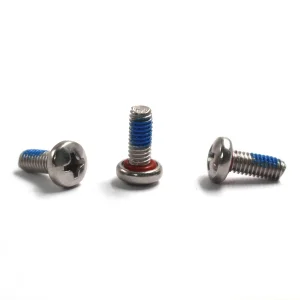
Electric vehicle thermal actuators and steering knuckle positioners demand fine-pitch metric set screws (M1.6 to M4) with micro-encapsulated anaerobic adhesives (DIN 267-27). This arrests vibrational unseating while ensuring zero leakage under 120°C oil-submerged conditions.
In sub-millimeter optoelectronic setups, cup point displacement can distort delicate linear encoder glass. We deploy flat-point nylon-tipped and brass-tipped set screws that cushion locking contact against drive shafts, isolating sensitive rotary optical scales from mechanical deformation.
Utilizing high-tensile alloy steels (SCM435, 12.9 grade) and titanium Ti-6Al-4V, our specialized high-torque dog-point set screws index critical gimbal mechanics and aircraft weapon carriage pylons, verified through ultrasonic flaw detection and 1000-hour ASTM B117 salt spray protocols.
| Set Screw Point Type | Reference Standards | Material Matrix | Engagement Characteristics | Ideal Industrial Application |
|---|---|---|---|---|
| Cup Point | DIN 916 / ISO 4029 / ASME B18.3 | Alloy Steel 45H / SUS304 / SUS316 | Digs into contact face for maximum anti-slip force | Pulley, collar, and gear attachment to shafts |
| Flat Point | DIN 913 / ISO 4026 / ASME B18.3 | Carbon Steel 12.9 / Stainless A2/A4 | Even pressure distribution without shaft wall scoring | Frequent repositioning on hardened shaft surfaces |
| Cone Point | DIN 914 / ISO 4027 / ASME B18.3 | High Carbon Tempered Steel / Brass | Permanent axial positioning via drilled conical detent | Precision pivotal shafts, hinges, and indexing pins |
| Dog Point (Full/Half) | DIN 915 / ISO 4028 / ASME B18.3 | Alloy Steel 45H / Titanium Gr. 5 | Cylindrical tip guides into pre-machined shaft grooves | Rotational stop limits and linear guides without binding |
Facilitating seamless international transactions through certified environmental control, supply chain redundancy, and 24-hour engineering collaboration.
With operational footprints in Dongguan (HQ), Shaoguan, and Wuhan spanning over 20,000 m², YH Fasteners shields buyers from local supply bottlenecks, guaranteeing steady capacity scaling up to tens of millions of micro-fasteners weekly.
Full regulatory governance adhering to EU Directive 2011/65/EU (RoHS 2.0), Annex XVII of REACH, and Dodd-Frank Act conflict-free sourcing protocols. Certified laboratory XRF spectral analysis is provided with every shipment lot.
Our sales engineering team provides instant design-for-manufacturability feedback. Upload 2D CAD or 3D STEP models to receive tolerance optimization, cold-heading feasibility, and cost-reduction proposals within 24 business hours.
Direct export experience across 60+ countries worldwide. We offer Vendor-Managed Inventory (VMI), blanket purchase agreements with JIT drop shipping, and barcode-integrated desiccated vacuum packing for zero corrosion transit.
Strategic engineering vectors dictating the next 5 years of fastener evolution at YH Fastener manufacturing plants.
In response to augmented reality (AR) optical chassis and medical implant sensors, we are refining ultra-micro tooling capaz of cold-heading M0.6 to M0.9 set screws with concentricity held within ±0.003mm, setting new global benchmarks for micro-drive accuracy.
Developing micro-slurry 360-degree nylon and polyamide thread patches with sub-micron film uniformity. This guarantees uniform installation torque and reliable locking even after 5-10 disassembly and maintenance cycles in automotive suspension modules.
Integrating in-die acoustic emission sensors and AI vision during cold heading. Each machine setup automatically detects and ejects minute tooling wear deviations before parts reach thread-rolling, driving continuous Cpk performance above 1.67.
In-depth answers addressing design tolerances, metallurgical selections, and global contract delivery standards.
DIN 916 (Cup Point) features a specialized thin, cup-shaped circular cutting edge at its tip that cuts directly into the surface of the mating shaft upon torquing, generating superior holding power against high torsional and axial forces. However, it permanently dents the shaft surface. Conversely, DIN 913 (Flat Point) has a ground or cold-formed planar contact face that exerts clamping pressure without marring or scoring the shaft, making it ideal for assemblies requiring frequent maintenance, adjustment, or delicate thin-walled tubing.
Hex stripping is typically caused by insufficient punch depth, irregular socket geometry, or improper heat treatment. We mitigate this through cold heading with hardened high-speed steel punches that maintain parallel socket walls with zero taper. Additionally, our continuous mesh-belt protective atmosphere heat-treatment lines guarantee accurate core tempering (HRC 45-53 for Grade 12.9) without surface decarburization, maximizing hex key drive contact without rounded edges.
Yes. We support custom micro-encapsulated adhesive coatings (DIN 267-27, like 3M Scotch-Grip or precote) and resilient polyamide/nylon patch coatings (DIN 267-28). Nylon patches provide prevailing torque for re-usable adjustment assemblies, while chemical micro-encapsulated threads burst during installation, delivering 100% thread gap sealing and permanent locking against extreme vibration.
Every commercial production batch is accompanied by comprehensive documentation: EN 10204 3.1 Material Certificate, dimensional measurement report (including pitch diameter, socket depth, total length), Vickers/Rockwell hardness test verification, surface plating thickness test reports (X-ray fluorescence), salt-spray corrosion chamber logs, and RoHS/REACH compliance letters.
Tooling design and pilot prototyping generally require 7 to 10 working days. Upon PPAP approval and customer sample sign-off, mass production lead times typically range from 15 to 25 days depending on batch volume, wire availability, and specialty secondary treatments (e.g., passivation, nylon patch application, or black oxide finishing).
Complete mechanical product line coverage for plastics, electronics, cabinetry, and structural joining systems.