Explore factory-direct engineered fasteners fabricated via cold-heading, CNC Swiss micro-machining, and robotic visual inspection lines for mission-critical joints.
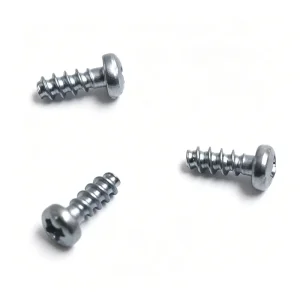
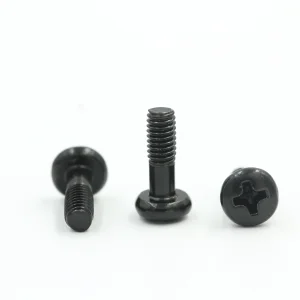
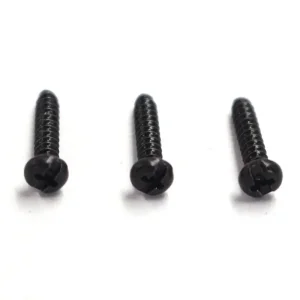
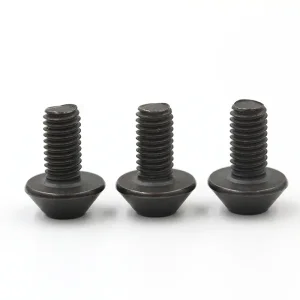
How engineered shaft locking screws eliminate fretting corrosion, tangential slippage, and high-harmonic vibrational backing-out in precision electro-mechanical assemblies.
Standard set screws rely exclusively on friction underneath the cup or cone point. Under high rotational velocity and axial shock loads, microscopic elastic deformations lead to rapid clamp-load decay.
Modern shaft locking screws utilize engineered 360-degree polyamide patches, micro-encapsulated chemical adhesives, or split-collar mechanical geometry that creates continuous positive thread engagement, passing 30,000-cycle Junkers transverse vibration benchmarks without loosening.
Traditional hardened steel cup points create circular gouges, stress risers, and burrs on precision-ground rotor shafts, severely damaging bearings during teardown and servicing.
Advanced OEM suppliers engineer brass-tipped, copper-inserted, or soft-alloy flat-point shaft locking screws. These distribute radial clamping pressure across an optimized contact arc, safeguarding shaft runout tolerances within <0.002 mm.
In automotive motor housings and aerospace gimbals, components undergo severe thermal cycling from -40°C to +150°C. Thermal expansion differentials between alloy shafts and housings cause thermal ratcheting.
By leveraging austenitic stainless steel grades (A2-70, A4-80) and precision-tempered SCM435 chrome-molybdenum steel with micro-layered zinc-nickel passivations, modern shaft locking screws retain constant clamping force across extreme thermal envelopes.
Procurement directors and quality engineers face severe downstream liabilities when sourcing mechanical fasteners. What global Tier-1 industrial buyers demand from an audited OEM manufacturer:
| Evaluation Parameter | Standard Commercial Fastener | YH Precision OEM Shaft Locking Screws | Impact on Assembly Yield & Reliability |
|---|---|---|---|
| Thread Profile & Class | Commercial 6g / 6H rolling | Precision Class 4h/5h or 6g tight tolerance rolling | Eliminates thread wobble and ensures concentric clamping force without shaft eccentric deflection. |
| Core Hardness & Microstructure | Generic batch quenching (uneven) | Continuous mesh-belt furnace controlled atmosphere quenching (32-39 HRC / 45-52 HRC) | Eliminates internal hydrogen embrittlement; provides superior fatigue life under cyclic torsional shock. |
| Defect Rate & Optical Sorting | AQL 1.0 - 1.5 manual sampling | 100% High-Speed Multi-CCD Visual Sorting (<15 PPM guarantee) | Essential for automated bowl-feeder robotic assembly lines; prevents automated driver jamming and downtime. |
| Corrosion Resistance | Standard Blue Zinc (48-72h salt spray) | Multi-layer Zinc-Nickel (Zn-Ni) + Nano-Sealant (1000h+ red rust ASTM B117) | Guarantees zero chemical degradation in marine, industrial chemical, and automotive under-hood installations. |
| Traceability & Validation | Basic CoC (Certificate of Conformance) | Full PPAP Level 3 documentation, IMDS registration, RoHS/REACH, 3.1 Mill Test Reports | Accelerates automotive and medical device compliance audits, ensuring complete batch traceability back to raw wire billet. |
How advanced cold-heading automation, localized supply chain integration, and digital twin monitoring create an unbeatable strategic advantage for worldwide hardware buyers.
Equipped with 5-station and 6-station high-speed cold formers, raw wire is plasticized without cutting grain boundaries. This continuous crystalline grain flow yields a 30% higher shear strength compared to conventionally machined set screws.
In-house tooling fabrication with ultra-hard tungsten carbide dies enables prototype iterations in 3 to 5 days. Proprietary cold-heading tooling preserves drive socket recesses (Torx, Hex, Spline) without premature stripping.
100% automated optical inspection systems evaluate head dimensions, shank straightness, thread pitch accuracy, and recess depth at speeds up to 1,200 parts/min, eliminating defective fasteners from entering shipments.
Operating across Dongguan, Shaoguan, and Wuhan, our manufacturing triad benefits from same-day wire annealing, continuous plating facilities, and chemical coating suppliers, slashing standard lead times by 40%.
From sub-millimeter robotic encoders to high-vibration drone gimbal motor stators, our engineered shaft locking screws are built to withstand rigorous operating conditions.
High-RPM brushless DC (BLDC) motors generate severe rotational inertia and thermal heat spikes. Custom M3 to M8 shaft locking screws clamp resolver wheels and timing pulleys tightly to the central rotor shaft without radial slippage.
Multi-axis articulated surgical arms require zero backlash. Passivated 316L stainless steel shaft screws secure delicate harmonic drive couplings and rotary encoders, ensuring sub-micron positional repeatability under sterilization protocols.
Camera payload stabilization systems face high-frequency rotor harmonics. Ultra-lightweight titanium and micro-pitch alloy screws with pre-applied blue or yellow nylon locking patches prevent optical drift under continuous dynamic vibration.
Common inquiries from mechanical design teams, sourcing specialists, and manufacturing engineers regarding shaft locking hardware specifications and manufacturing tolerances.
Standard DIN 916 screws feature a basic cup point designed for static holding through thread wedging. An OEM shaft locking screw includes specialized engineering features—such as nylon thread patches (prevailing torque), brass/nylon non-marring tips, fine-thread pitch variations (Class 4h/6g), or captive split collar integration—designed to maintain preload under severe angular shock, high RPM, and thermal oscillation.
Pre-applied micro-encapsulated adhesive or polyamide nylon patches eliminate human error (such as over/under dispensing), avoid liquid dripping onto sensitive optical or electronic components, allow immediate downstream handling without a 24-hour curing delay, and reduce total assembly station cycle time by up to 35%.
We manufacture: (1) Cup Point: High holding power against semi-hard shafts; (2) Flat Point: For frequent repositioning without scoring ground shafts; (3) Brass/Nylon Tip: Zero-damage clamping for aluminum, carbon fiber, or micro-finished shafts; (4) Dog/Cone Point: Locates into pre-drilled shaft grooves for positive geometric locking.
Yes. Utilizing high-precision CNC Swiss lathes and specialized micro-cold formers, we routinely manufacture micro-locking fasteners down to M0.8 and M1.2 sizes with Torx Plus or micro-hex sockets for camera lens mechanisms, medical endoscopy probes, and precision wearable electronics.
Every shipment is backed by ISO 9001, ISO 14001, and IATF 16949 certified quality management protocols. Standard delivery includes 3.1 Mill Chemical & Mechanical Test Reports, Rockwell/Vickers Hardness verification, Salt Spray Test logs, optical inspection PPM reports, and full RoHS/REACH compliance documentation.
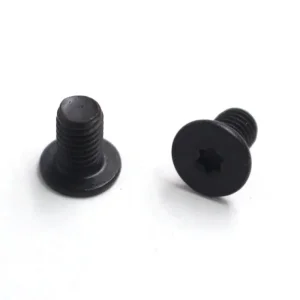
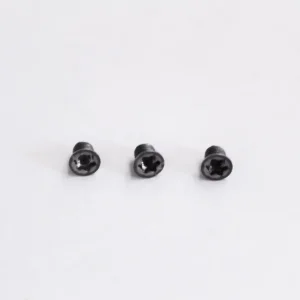
We recommend migrating from standard Phillips or generic internal hex to Torx (6-Lobe) or Torx Plus drive profiles. Torx geometry offers vertical sidewalls with near-zero cam-out force, prolonging bit lifespan by up to 10x and ensuring accurate torque-to-clamp translation in automated driving cells.
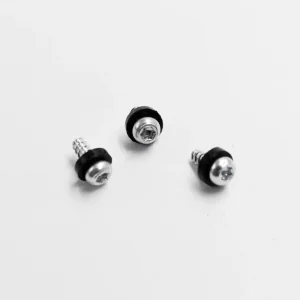
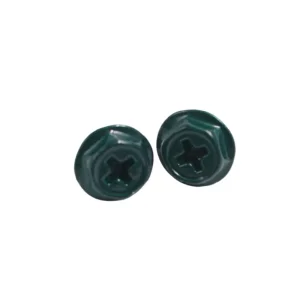
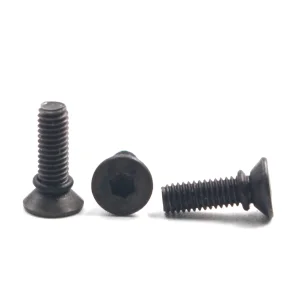
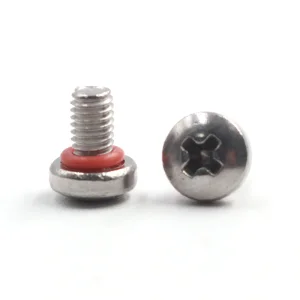
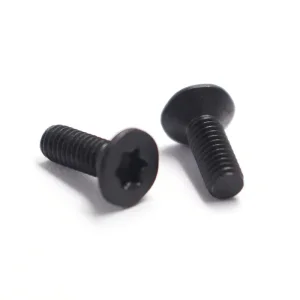
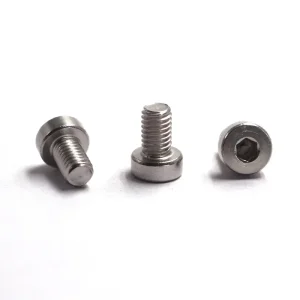
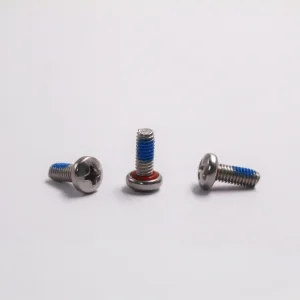
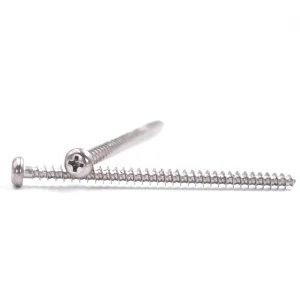
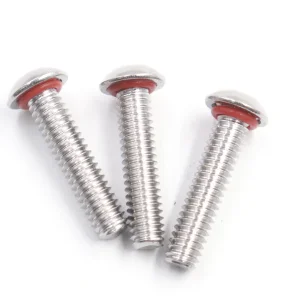
High-durability sealing fasteners, nylon patch anti-loosening screws, and precision SEMS hardware engineered for electrical enclosures, powertrain housings, and mechanical assemblies.
From initial CAD review and Finite Element Analysis (FEA) to pilot cold heading, heat treatment validation, and global JIT delivery.
Our applications team assesses torque envelopes, shear margins, mating shaft hardness, and plating requirements, responding with detailed DFM suggestions within 24 hours.
In-house CNC EDM and precision grinding fabricate carbide cold-forming dies, providing initial engineering samples (FOT) with comprehensive CMM dimensional inspection in 5 to 7 days.
Atmosphere-controlled continuous furnaces perform precise carburizing or neutral hardening. Surface finishing options include RoHS-compliant trivalent zinc, zinc-nickel alloy, black oxide, or PTFE coatings.
With automated bagging, VCI anti-rust barrier packaging, barcoded lot tracking, and bonded warehouse reserves, we support JIT delivery directly to Tier-1 hubs across North America, Europe, and the Asia-Pacific.
