+86 131 7840 7856 WhatsApp Dongguan · Shaoguan · Wuhan, China

ODM Custom Self Tapping Screw Manufacturers & Supplier

Precision Cold Heading, Custom Thread Geometry, and High-Throughput Manufacturing Delivering IATF 16949-Certified Structural Fastener Solutions Worldwide.

IATF 16949 / ISO 9001 Certified 100% Optical Sorting 24h Engineering Review
Manufacturing Intelligence

The Strategic Advantages of Sourcing Custom Self Tapping Screws in China

Overcoming modern assembly challenges with advanced metallurgic control, rapid multi-station heading, and end-to-end supply integration in Guangdong manufacturing hubs.

20,000 m²
Dedicated Production Base
30+ Yrs
Tooling & Cold Heading Mastery
< 50 PPM
Automated Optical Defect Rate
60+ Countries
Global Distribution Reach

Full Supply Chain Cluster

Situated in Dongguan, Shaoguan, and Wuhan, our factories leverage immediate proximity to raw wire drawing, multi-stage annealing, automated plating, and mold fabrication hubs. This localized ecosystem compresses delivery lead times for specialized cold-heading dies and wire stocks from weeks to hours.

Advanced Metallurgical Control

Self tapping into high-tensile sheet metals and complex engineering plastics requires tightly calibrated surface-to-core hardness gradients. Our continuous mesh-belt carburizing and carbonitriding furnaces provide exact case depths (0.05–0.20 mm) that prevent tip blunting while retaining core ductility against dynamic shear stress.

Bespoke OEM/ODM Tooling Capacity

Rather than relying strictly on catalog standards, our in-house tooling workshop configures multi-lobe recesses (Torx, Tamper-proof, Tri-wing), custom underhead serrations for grounding, and customized thread relief angles that reduce driving resistance while preventing material boss splitting.

Future Perspectives

Emerging Trends Shaping the Self Tapping Fastener Industry

Technological innovations driven by clean mobility, robotic automated screwdriving, and high-performance polymer assemblies.

High-Speed Robotic Feeding

Automated assembly cells demand screws with strictly held geometric head concentrics and lead chamfers to prevent hopper and nozzle jamming during high-RPM automatic blow-feeding.

Trilobular Flow Threads

Thread-forming screws featuring triangular cross-sections displace rather than cut mating substrates, reducing thread debris within sealed electronics while ensuring high vibration security without loctite.

Cr-Free Eco Plating

Trivalent passivation, zinc-nickel coatings, and PTFE topcoats yield upwards of 1,000+ hours in neutral salt spray (ASTM B117) without causing hydrogen embrittlement in case-hardened steel.

Integrated Sealing Elements

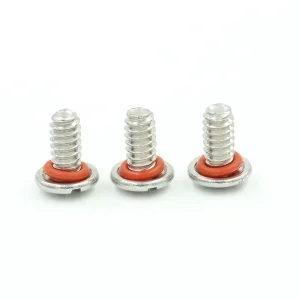
Pre-assembled fluorosilicone O-rings and bonded elastomeric washers deliver instant IP67/IP68 ingress protection against fluid migration along the pilot hole flanks in exterior enclosures.

Application Engineering

Specialized Substrate Scenarios: Engineering Real-World Joints

Different materials exhibit distinct mechanical plasticity, thermal expansion, and modulus rates. Custom thread geometries maximize clamping force while preventing stripping.

Thermoplastics & Structural Resins

Fastening into ABS, Polycarbonate, or glass-filled PA requires a sharp 30° flank angle or asymmetrical threads. This profile displaces plastic into deep thread valleys, significantly widening the gap between drive torque and strip-out torque to eliminate boss bursting.

Automotive Body Panels & Brackets

Thin gauge cold-rolled sheet steel and extruded aluminum stampings depend on thread-rolling screws with induction-hardened lead points. The fasteners generate extruded collars during penetration, tripling effective thread engagement length without requiring cage nuts.

High-Vibration Electronic Chassis

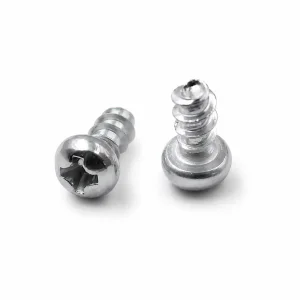
Miniature M1.2 to M3.0 self-tapping pan head screws configured with micro-encapsulated thread-locking adhesives or pre-fused blue polyamide patches prevent harmonic joint relaxation in servers, telecommunications modules, and drone frames.

Turnkey Engineering

Comprehensive Macro Industry Solutions

Aligning engineering design, automated process flow, and metallurgic excellence with mission-critical market sectors.

New Energy & Battery Modules

  • Non-magnetic 304/316 austenitic stainless grades to prevent induction loops.
  • Pre-applied dielectric nylon coatings along shanks to inhibit galvanic degradation.
  • Zero-debris thread rolling profiles to avoid short-circuit risk inside battery enclosures.

Engineered for high current density environments and extreme safety standards.

Smart Consumer Electronics

  • Ultra-low profile wafer and pancake head profiles to fit micro-clearance enclosures.
  • Precise Torx Plus (IP) drives to enable robotic tooling bit life exceeding 50,000 insertions.
  • Optical sorting verification for head diameter and thread pitch within ±0.02 mm tolerances.

Enabling compact structural integrity across phones, cameras, wearables, and IoT modules.

Industrial Control & Fluid Ingress

  • Precision underhead grooves with vulcanized EPDM or fluoro-elastomer seals.
  • Anti-tamper drive patterns (snake-eye, triangle, pinned Torx) for public security hardware.
  • Salt spray resistance exceeding 720 hours without base metal corrosion.

Delivering reliable, moisture-tight clamping across junction boxes and outdoor telemetry.

Procurement Framework

Addressing Global Enterprise Sourcing Requirements

Meeting the exacting supply chain criteria of multi-national OEMs, Tier-1 system contractors, and industrial distributors.

PPAP Level 3 Documentation

Full production part approval process support, including Control Plans, FMEA, Gage R&R, Material Test Reports, and Dimensional Layout Results for high-accountability automotive programs.

Full Raw Material Traceability

Heats tracked straight from steel mills through forming, carburizing, and shipment. Full spectral verification ensures zero substitution of sub-par wire stocks across all production lots.

Vendor Managed Inventory (VMI)

Custom buffer stocking programs, barcode-labeled safety stock reserves in regional hubs, and lean JIT delivery logistics prevent assembly plant line-down situations.

RoHS, REACH & Conflict Minerals

Strict environmental and regulatory compliance verified via third-party chemical testing laboratories (SGS, TUV), guaranteeing non-toxic surface treatments and ethical raw-material origins.

Knowledge Exchange

Frequently Asked Technical Questions (FAQ)

Clear engineering answers addressing fastener selection, stripping resistance, cold-heading feasibility, and testing methodology.

What is the functional difference between thread-cutting and thread-forming self tapping screws?
Thread-cutting screws feature integrated flute notches along their taper that physically cut material fibers to create a mating thread, making them ideal for harder brittle plastics, cast metals, and resin composites where internal stress relief is vital. Thread-forming screws feature continuous blunt lobes (such as trilobular geometries) that mechanically cold-flow or burnish the mating substrate without generating chips, providing superior anti-vibration clamp load in ductile metals and soft thermoplastics.
How do you calculate optimum pilot hole diameter for custom self tapping screws in plastics?
The ideal pilot hole diameter generally corresponds to the screw's pitch diameter (roughly midway between the major and minor thread diameters), typically around 0.80 to 0.88 times the nominal outside diameter, dependent on the resin's flexural modulus. For high-modulus materials like polybutylene terephthalate (PBT) or glass-filled polymers, hole sizes are enlarged by 2–5% to prevent boss cracking, while boss counterbores are recommended to avoid localized stress concentrations at the surface entry.
What quality measures eliminate thread stripping during automated pneumatic or electric screwdriver operations?
Stripping happens when the assembly line's operational torque overlaps with the failure torque. We engineer a minimum 1:3 ratio between drive-in torque and stripping torque by optimizing thread pitch, flank angle, and thread lead taper. Additionally, 100% optical sorting equipment screens out parts with burrs, irregular lead-in angles, or distorted thread crests that could produce premature driving resistance and false torque shut-offs.
How does YH Fastener protect hardened carbon steel screws against hydrogen embrittlement?
Case-hardened self tapping screws with hardness exceeding 320 HV (roughly Rockwell C 32) are susceptible to delayed brittle fracture if atomic hydrogen is absorbed during acid pickling or electroplating. We mitigate this through controlled non-acid mechanical descaling where appropriate, followed immediately by mandatory de-embrittlement baking at 200°C–220°C for 4 to 12 hours within 1 hour post-plating, confirmed via stress rupture testing under sustained tension.
What lead times and minimum order quantities apply to non-standard custom thread geometries?
For custom ODM head styles, drive systems, or unique pitches, tooling fabrication requires roughly 10–14 business days. Prototype sample validation batches typically ship within 5–7 days following die completion. Full production lead times range between 3 to 4 weeks depending on the surface coating. Minimum order quantities typically start at 50,000 to 100,000 units depending on diameter (M1.2–M8.0), optimized around header cold-drawing coil efficiency.

Accelerate Your Program with Tailored Fastening Engineering

Send our senior engineering team your 2D drawings, 3D CAD step files, or target substrate specifications. Receive an actionable DFM design review, torque balance recommendation, and quotation within 24 hours.

Submit Drawings for Engineering Evaluation