Explore high-retention self-tapping machine variants, waterproof sealing integrations, and micro-thread geometries built to eliminate stripped threads and joint relaxation.
As modern manufacturing pivots toward lightweight structural metals, automated robotic assembly, and harsh environment deployments, mechanical fastener procurement has shifted from a commodity purchase to a core design-for-manufacturability (DFM) discipline.
Global procurement teams in electric vehicle manufacturing and white goods assembly mandate strict fastener dimensional stability. Screws utilized in automated bowl feeders require flawless shank straightness, recess depth consistency, and flash-free head forming to prevent expensive assembly line stoppage.
The acceleration of 5G communications hardware, aerospace structural brackets, and battery enclosures involves fastening ultra-thin aluminum alloys, galvanized high-strength steel (AHSS), and stamped brass. Specialized thread geometries prevent boss blowout, stripped internal threads, and substrate deformation.
Modern micro-mobility, automotive electronics, and server chassis operate continuously under broadband vibrational profiles. Conventional thread pitches face thread loosening over time; procuring thread-forming tapping screws with engineered tri-lobular profiles or integrated under-head serrations guarantees long-term clamping retention.
From ultra-thin consumer electronic casings to energy storage enclosures exposed to chemical spray, custom-engineered tapping screws provide reliable clamping force without requiring tapped nuts.
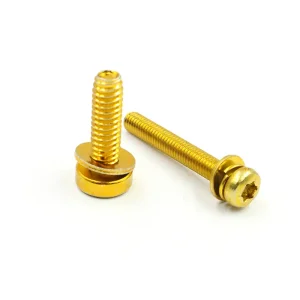
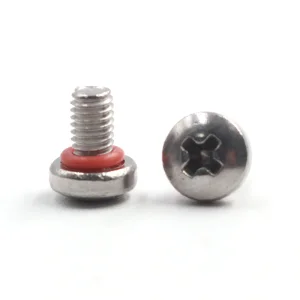
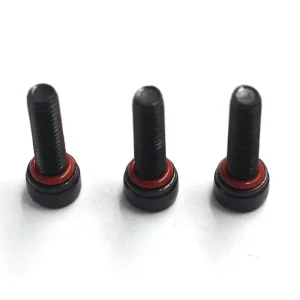
Delivering high clamp loads through structural aluminum battery trays without particulate debris. Incorporates proprietary micro-encapsulated threadlockers, sealing O-rings, and zinc-nickel plating to withstand 1,000+ hours of neutral salt spray (NSS).
Thin cold-rolled sheet steel structures benefit from self-extruding sheet metal tapping screws that generate their own extruded collar, doubling engaged thread count and supporting rapid structural panel installation.
Solar mounting brackets and air handling units encounter intense thermal cycling and wind shear. Our 304/316 austenitic stainless steel and bi-metal tapping screws offer rapid penetration with zero stress corrosion cracking (SCC).
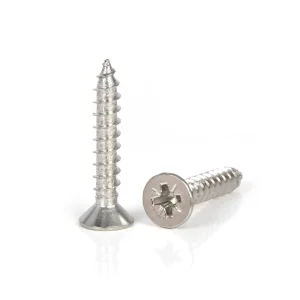
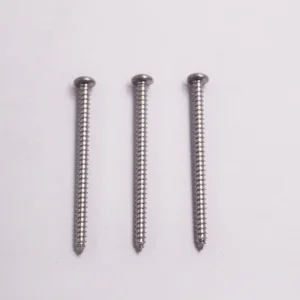
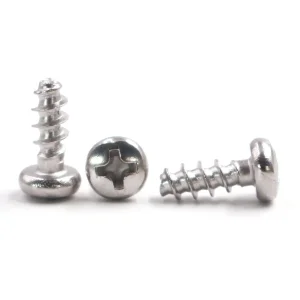
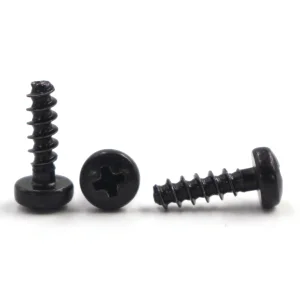
Micro-diameter sheet metal tapping screws (M1.0 to M2.5) featuring low-profile pan, countersunk, or wafer heads designed specifically for internal chassis grounding, camera modules, and precision handheld devices.
Discover our engineered metallurgical lifecycle, driven by in-house tool design, continuous mesh belt furnace hardening, and optical sorting algorithms that protect Tier-1 assembly yields.
Utilizing high-speed Italian and Taiwanese multi-station heading machines, we deform selected wire stock (AISI 1022A, 10B21, SUS304/316) along unbroken metallurgical flow lines. This eliminates interior micro-fractures, maximizing head-to-shank shear resistance under torsional peaks.
Precision flat and cylindrical rolling dies form the threads via plastic displacement rather than cutting. This densifies the flank grain matrix, creating thread crests that smoothly displace sheet metal fibers while reducing driving torque by up to 35% compared to standard machine screws.
Continuous-atmosphere mesh belt furnaces achieve a minimum case hardness of 450-550 HV for penetrating sheet panels, paired with a tough core hardness (270-390 HV) that absorbs cyclic operational shock and prevents catastrophic brittle failure.
Electroplated carbon steel components immediately undergo baking at 200°C ± 5°C for 4 to 8 hours to eliminate trapped hydrogen atoms. Surface treatments include eco-friendly trivalent zinc, zinc-nickel alloy, Geomet, Dacromet, and electropolishing.
High-speed glass disc sorting machines inspect shank runout, total pitch uniformity, recess filling, head diameter, and plating completeness. Out-of-tolerance components are air-ejected, securing an ultra-consistent incoming quality rate for robotic assembly lines.
Review additional custom solutions designed to integrate seamlessly into high-vibration, corrosive, and demanding multi-material fastening joints.
Streamlining international customs clearance and environmental auditing through rigorous chemical governance, complete raw material traceability, and automated documentation.
All plating options (zinc clear, black zinc, Dacromet, nickel) operate in total accordance with EU Directives 2011/65/EU and 2015/863. Full laboratory SGS and chemical spectroscopic reports are issued per master heat batch to eliminate customs compliance friction.
For high-tier automotive and safety-critical industrial joints, our QA lab issues complete Production Part Approval Process (PPAP) documentation packages, including Control Plans, Process FMEA, Gage R&R, and dimensional Cpk capability data.
Supporting international OEM supply chains through structured Vendor-Managed Inventory (VMI), safety buffer stock reservations in Dongguan, Wuhan, and Shaoguan, and export-compliant barcoded seaworthy packaging.
Comprehensive engineering clarifications addressing hole sizing, driving torques, galvanic corrosion, and manufacturing minimum orders.