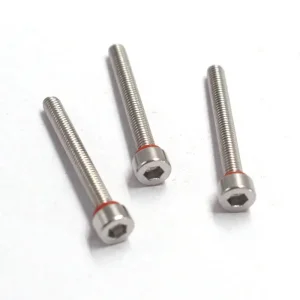
Explore our certified cold-headed screws engineered to eliminate galvanic degradation, resist high-frequency harmonic vibration, and deliver guaranteed IP67/IP68 environmental sealing across clean tech cabinet chassis.
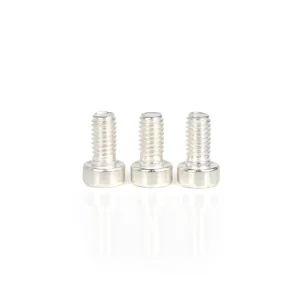
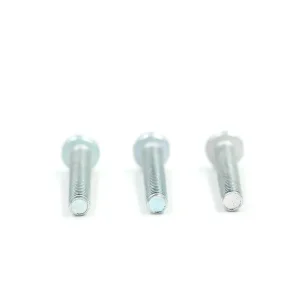
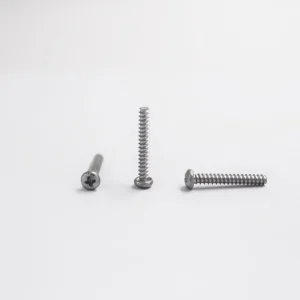
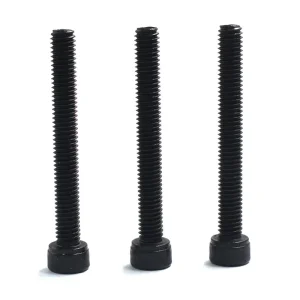
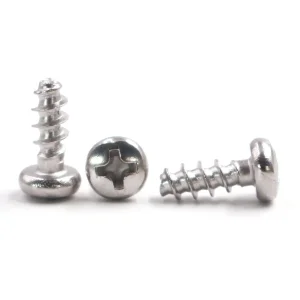
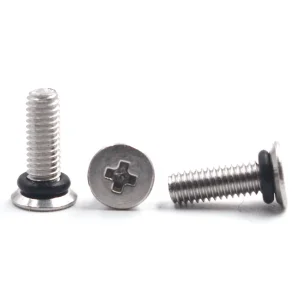
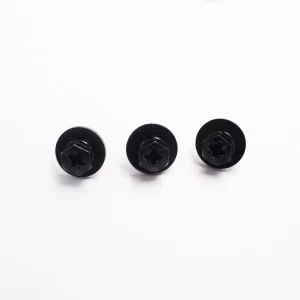
The transition toward decawatt-scale clean energy generation and electrochemical storage has imposed unprecedented physical demands on electrical enclosures, switchgears, and battery containment structures.
Traditional carbon steel screws accelerate galvanic corrosion when clamped onto aluminum busbars, zinc-plated cabinet panels, or copper grounding rails. Custom ODM fastener engineering formulates zinc-nickel, geomet, or specialized passivated austenitic stainless steels (304, 316, 316L) to eliminate potential differences and prevent premature galvanic degradation in coastal and high-humidity installations.
Megawatt utility inverters and transformer cabinets experience persistent high-frequency electromagnetic micro-vibrations, while grid-scale BESS modules face transportation dynamics and cooling fan resonances. Conventional standard screws suffer preload relaxation. Advanced micro-encapsulated nylon thread patching and serrated SEMS captive washers secure constant clamping force without manual re-torquing.
Liquid-cooled battery enclosures require absolute IP67 or IP68 airtight containment to prevent moisture entry that could provoke short circuits, while maintaining certified structural release limits during degassing events. Cold-headed sealing screws featuring integrated silicone or fluoro-elastomer (FKM) O-rings seated in undercut heads ensure true 360-degree radial sealing against cabinet surfaces.
From subsea-adjacent floating PV combiner boxes to desert utility energy storage systems, tailored mechanical fasteners anchor clean tech ecosystems.
Clamping prismatic cell modules, rack sliding rails, and battery management system (BMS) logic controllers. Uses non-magnetic stainless steel, vibration-damping prevailing torque screws, and insulation-coated fastener heads preventing arc flashes.
Securing power conversion systems (PCS), heatsinks, and IGBT modules subjected to continuous thermal cycling (-40°C to +125°C). Requires fine-pitch metric threads and SEMS spring-conical double washer assemblies for consistent preload holding.
Mounting liquid-cooling fluid manifolds, high-voltage busbars, and public-access outer architectural casings. Deploys tamper-resistant security heads (Pin-Torx, triangular recess) and integrated grounding screws with paint-cutting underhead teeth.
Safeguarding yaw-control converters and pitch electrical cabinets located offshore or in high-wind regions. High-tensile Class 8.8 and 10.9 alloy steel screws treated with multi-layer Dacromet or Geomet finishes passing 1,500+ hour salt-spray testing.
A fastener in an industrial new energy cabinet is not a generic commodity—it is a critical mechanical spring operating within a complex thermal, electrical, and chemical matrix.
Unlike machined fasteners that interrupt metal grain boundaries, cold heading retains continuous metallurgical grain flow from the screw head to the thread crest. High-speed multi-station headers preserve tensile tenacity, eliminate stress concentrations at the head-shank radius, and ensure structural load resistance under shock loading.
Standard flat washers curl under torque, opening micro-channels for moisture. Our ODM sealing screws integrate a precision under-head groove that controls elastomeric deformation. The O-ring (silicone, Viton, or HNBR) compresses to exactly 30% volume, achieving IP68 hermetic isolation without extrusion under high assembly torque.
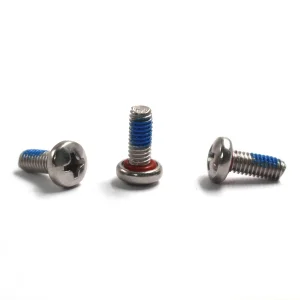
Pre-applied polyamide 360-degree patches and micro-encapsulated anaerobic adhesives (DIN 267-27 standard) eliminate reliance on manual threadlockers during assembly. Upon driving, micro-capsules rupture, releasing reactive adhesive that bonds the thread flanks, maintaining up to 90% residual torque even after 10 million vibration cycles.
| Material / Grade | Yield Strength (MPa) | Corrosion Resistance | Primary Cabinet Application | Compliance Standards |
|---|---|---|---|---|
| Austenitic SS 304 (A2-70) | 450 – 700 | 500 hrs NSS (Passivated) | Internal chassis framing, PCB mounting, busbar covers | RoHS / REACH |
| Marine SS 316 / 316L (A4-80) | 600 – 800 | 1,200 hrs NSS (C5-M rated) | Outdoor seaside BESS, coastal PV combiner boxes | ISO 3506-1 |
| Carbon Steel 8.8 / 10.9 + Geomet | 640 – 940 | 1,500 hrs NSS (No red rust) | Structural framing, seismic anchor brackets, heavy busbars | IATF 16949 / ISO 898-1 |
| Bimetal (SS Shank + Steel Point) | 750 – 900 | 1,000 hrs NSS (Zinc-Alloy) | Self-drilling structural enclosure sheets & canopy flashing | DIN 7504 |
Dongguan, Shaoguan, and Wuhan manufacturing plants provide a robust, agile supply chain network designed to eliminate stockouts and compress development cycles.
Our tri-site infrastructure integrates precision wire drawing, high-speed multi-stage cold heading, thread rolling, continuous vacuum heat treatment, and automated surface electroplating. Controlling the full manufacturing cycle in-house reduces subcontracting risk and ensures lot-to-lot dimensional consistency.
Clean energy assembly plants rely heavily on automated screw-driving robotics. A single defective head recess or deformed thread can halt a production line. Our facilities utilize multi-camera optical eddy-current inspection platforms that verify 100% of fastener geometry at speeds up to 1,200 parts/minute, securing zero-defect targets.
Standard catalogs rarely fulfill custom new energy enclosure specifications. Our internal tool-and-die center engineers custom carbide punches, dies, and rolling dies within 3 to 7 business days. Engineering teams provide full DFM reviews, FEA stress modeling, and functional prototypes within 24 to 48 hours from receiving your 2D/3D CAD models.
Entering North American, European, and Asia-Pacific energy markets demands adherence to international safety, environmental, and quality regimes.
Our quality management system enforces stringent APQP (Advanced Product Quality Planning) and PPAP Level 3 documentation. Every batch is traceable down to the raw material steel heat number, wire drawing batch, heat treatment chart, and electroplating tank log.
All non-metallic components—including O-ring seals, under-head insulating nylon washers, and thread-locking patches—comply with UL 94-V0 self-extinguishing ratings and withstand continuous working temperatures exceeding 150°C without outgassing hazardous halogens.
Zero hexavalent chromium (Cr6+), lead, mercury, cadmium, or hazardous substances in our plating chemistries. Fully documented testing via third-party laboratories (SGS, TÜV) guarantees frictionless customs clearance and environmental stewardship globally.
Anticipating next-generation solid-state battery storage architectures, 1,500V ultra-high voltage arrays, and automated megawatt factory rollouts.
Development of piezo-resistive thin-film sensor heads providing direct digital telemetry of residual clamp force. Enables remote health monitoring across unmanned desert solar fields and offshore wind transformer stations.
Pioneering the commercial cold heading of duplex 2205, 2507, and Grade 5 Titanium fasteners for near-shore and maritime floating solar arrays exposed to severe salt crystallization and splash-zone conditions.
Re-engineering fastener head lead chamfers, Torx-Plus driver profiles, and self-centering thread guides tailored for high-speed multi-axis automated screwdriving cells in Gigafactories, eliminating cross-threading.
Adoption of 100% scrap-recycled green electric arc furnace (EAF) wire rods combined with low-temperature chemical coatings, reducing the embodied carbon of each fastener by 45% for rigorous ESG procurement mandates.
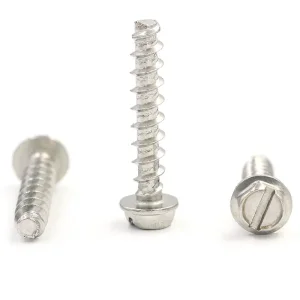
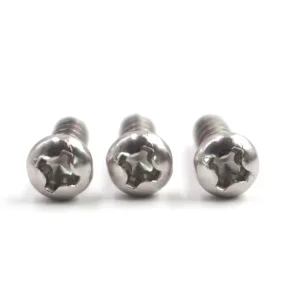
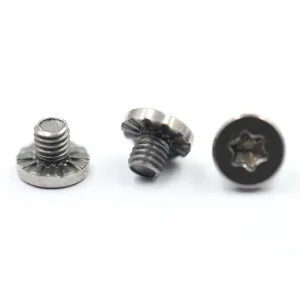
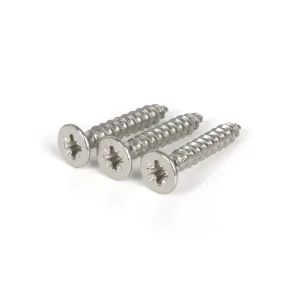
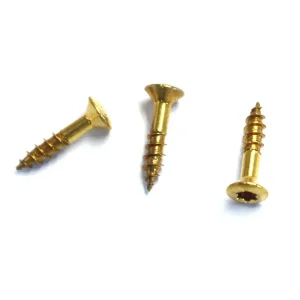
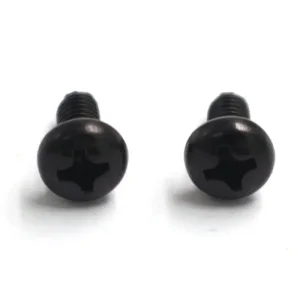
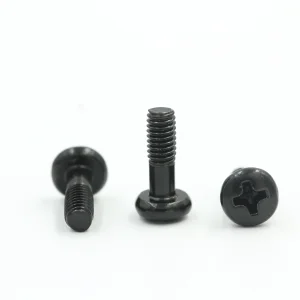
Review the second series of specialized screws, threaded cutting fasteners, and hermetic sealing hardware engineered for advanced battery packs, electrical panels, and marine-grade equipment.
Comprehensive answers formulated by our chief metallurgists and application engineers for procurement specialists, structural engineers, and quality assurance managers.
Galvanic corrosion occurs when metals with differing electrochemical potentials come into electrical contact in the presence of an electrolyte. We resolve this by supplying austenitic stainless steel (304 or 316) screws finished with specialized non-conductive passivations, organic topcoats, or Geomet/zinc-nickel coatings. Additionally, we engineer pre-assembled captive isolating polyamide or EPDM washers that physically decouple the fastener head and shank from the aluminum enclosure sheet.
Cold-heading utilizes multi-die cold forming to deform wire rod into near-net shape along uninterrupted metallurgical grain flow lines, increasing tensile, shear, and fatigue strength by 20% to 30% without internal stress fractures. Conversely, CNC machining cuts across the metal's crystalline grain lines, introducing micro-notches that act as failure initiation points under persistent dynamic vibration. Cold heading also generates zero material scrap, delivering significant cost efficiency at scale.
Our sealing screws incorporate an engineered annular undercut beneath the screw head. During assembly torque application, the bonded O-ring (silicone, Viton, or fluorosilicone) is compressed radially inward into this recess rather than extruding outward. This engineered containment controls gasket squeeze to approximately 30%, preventing over-compression while forming an impenetrable barrier against moisture, pressurized water jets, and fine sand over decades of outdoor exposure.
Yes. Our in-house engineering team works directly with STEP, IGES, DXF, and DWG file formats. We analyze your mechanical joint requirements, recommend ideal head geometry (pan, hex, countersunk, or low-profile button), select optimal driver profiles (such as Torx or Torx-Plus for high-speed automated robotic feeding), and build dedicated carbide punches and thread rolling dies within our factory.
For high-frequency harmonic vibration environments, we recommend two primary mechanisms: (1) SEMS screws with pre-assembled split spring washers or conical Belleville tension washers that maintain active mechanical preload under thermal cycling; or (2) micro-encapsulated thread-locking adhesives (DIN 267-27) or polyamide patches applied 360 degrees around the thread circumference to prevent thread backing-off under severe dynamic loading.
All production facilities operate under strict IATF 16949 (Automotive Quality Management), ISO 9001 (Quality Management), and ISO 14001 (Environmental Management) standards. Our fasteners are thoroughly tested for chemical compliance under EU RoHS Directive 2011/65/EU and REACH Regulation (EC) No 1907/2006 (SVHC list), verified through full lot traceability and accredited laboratory reports.
For automated robotic screwdriving operations, fasteners must meet a zero-defect standard (<1 PPM). We deploy advanced continuous-feed optical sorting machines fitted with high-resolution telecentric lenses and eddy-current sensors. These systems inspect 100% of finished parts for total length, head diameter, drive recess depth, thread pitch integrity, and thread burrs before packaging.
For custom ODM fasteners requiring dedicated tooling, tool design and fabrication take 5 to 7 working days, followed by sample delivery within 3 days. Upon formal sample approval and PPAP sign-off, standard production batches (100,000 to 5,000,000+ pieces) typically ship in 15 to 25 business days. Rapid inventory buffering programs are also available for contracted annual call-offs.