Engineered to eliminate manual pre-assembly and provide permanent clamp load retention under aggressive cyclic vibration and thermal stress.
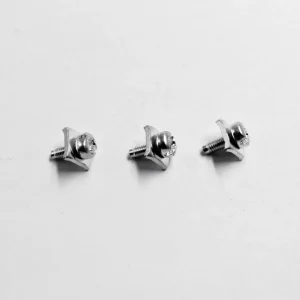
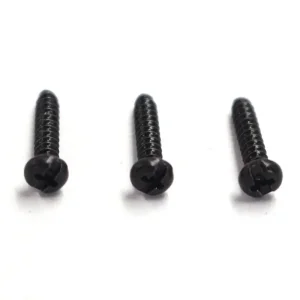
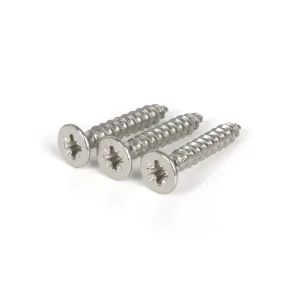
Transitioning from conventional discrete hardware assemblies to integrated cold-rolled SEMS components: Solving clamping relaxation, assembly line human error, and galvanic joint degradation.
SEMS screws (derived from "pre-asSEM-bled" fasteners) incorporate an unthreaded blank upon which internal-toothed, conical, split helical, or flat washers are loaded prior to thread rolling. The subsequent cold rolling thread formation expands the outside thread major diameter beyond the internal diameter of the washer.
This locks the washer captive under the screw head forever, allowing free axial rotation while prohibiting disassembly. In high-speed automated robotic pick-and-place lines, loose washers introduce catastrophic jam risks and variable torque friction coefficients. SEMS screws eliminate these failure points by standardizing the bearing surface contact interface.
Dynamic transverse loading in automotive chassis and electrified powertrains creates rapid bolt pre-load loss. Standard threaded fasteners rely solely on elastic elongation tension. In contrast, captive washer SEMS screws utilize specialized spring rate Belleville washers or serrated disc washers that maintain active stored kinetic deflection.
Under standardized DIN 65151 (Junker Test) regimes, our high-tensile captive washer combinations exhibit over 85% residual pre-load retention across 2,000 cycles at 12.5 Hz transverse displacement, compared to standard DIN 933/ISO 4017 bolts which lose up to 70% tension within 300 cycles.
Industry 4.0 automated screwdriving units with bowl feeders and magnetic or vacuum bit pickups demand micron-level dimensional stability. Separate washers stick together due to electrostatic charges, surface tension of residual protective oils, or stamping burrs.
By consolidating the fastener and washer into a unified part number, global OEMs eliminate secondary feeder tracks, minimize Bill of Materials (BOM) overhead, and slash feeder chute jamming rates down to less than 1 defect per 500,000 feed cycles (PPM < 2).
Precise chemical composition, hardening depth, and surface micro-hardness matching prevent washer bite galling, stress corrosion cracking (SCC), and hydrogen embrittlement.
| SEMS Configuration | Base Screw Material | Integrated Washer Spec | Surface Treatment / Plating | Target Mechanical Application |
|---|---|---|---|---|
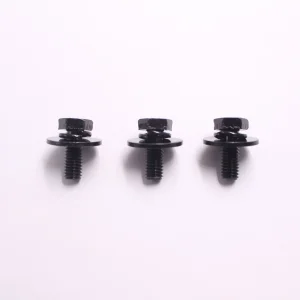
| Hex Head Double Washer SEMS | SCM435 Alloy Steel / 10B21 Boron Steel (Class 8.8, 10.9) | Hardened Flat Washer (HV 200-300) + DIN 127B Split Spring Washer | Geomet 500B / Delta Protekt (1000+ Hrs Salt Spray ASTM B117) | Automotive sub-frame, e-motor powertrain mounts, chassis grounding. |
| Pan Head Square Washer SEMS | Low/Medium Carbon Steel (1018A, 1022A) or Brass CuZn37 | Square Curved Pressure Clamp Plate with Serrated Edge Ribs | Acid Zinc / Trivalent Clear Cr3+ or Matte Tin Plating | Industrial switchgear, electrical distribution panels, breaker lugs. |
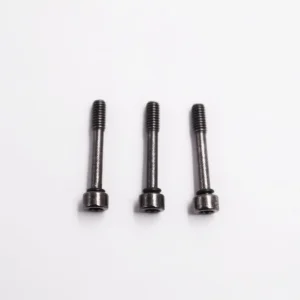
| Torx Pan Head External Tooth SEMS | AISI 304 (A2-70) / AISI 316 (A4-80) Austenitic Stainless | DIN 6797A External Serrated Tooth Washer / DIN 6798A | Electropolishing + Passivation (ASTM A967) / Anti-Friction Topcoat | Telecom 5G base station outdoor housings, solar inverters, medical enclosures. |
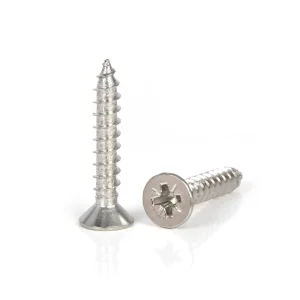
| Countersunk Flat SEMS (Conical Washer) | Case Hardened Carbon Steel C1022 with Core Hardness HRC 28-38 | DIN 6796 Conical Belleville Spring Washer (Hardened 420 Stainless) | Zinc-Nickel Alloy Plating (12-16% Ni) with High Corrosion Resistance | High-density rack servers, PCB backplane structures, dynamic power modules. |
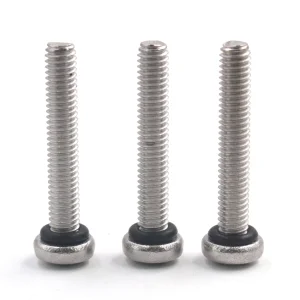
| Captive Sealing Washer SEMS | 304/316 Stainless Steel or Zinc Plated 10.9 Steel | Under-head Molded EPDM / Fluoroelastomer (Viton) Bonded Ring | Black Zinc Iron / Black Trivalent Passivation with Fluorocarbon Seal | IP67/IP68 submersible electronics, outdoor telecommunication cabinets, EV battery packs. |
Fasteners heat-treated to Class 10.9 or 12.9 (hardness > 320 HV) suffer catastrophic delayed brittle failure if atomic hydrogen generated during acid pickling or electroplating is trapped in the crystal lattice.
At YH Fastener, all electroplated high-tensile SEMS screws undergo immediate furnace de-embrittlement baking at 200°C–220°C for 4 to 8 hours within 1 hour post-plating. Alternatively, non-electrolytic zinc flake dip-spin coatings (Geomet, Magni) are applied to bypass acid pickling entirely.
Variability in tightening torque creates inconsistent clamp load ($F_p = \frac{T}{K \cdot d}$). If the washer bearing surface or under-head radius experiences friction fluctuations, up to 90% of applied torque is lost to parasitic thread and face friction.
We implement automated micro-encapsulated dry lubricants and controlled topcoats ensuring the nut/bearing surface friction coefficient ($\mu_{tot}$) remains within a tightly constrained window of $0.12 \pm 0.02$, ensuring deterministic automated clamping on robot lines.
Automated production yields zero margin for dimensional out-of-spec parts or inverted washers. Our post-production sorting utilizes 360-degree glass turntable high-resolution CCD optical vision systems coupled with multi-frequency eddy current crack detection.
Every single batch guarantees 100% sorting for washer existence, correct washer orientation, thread pitch profile, recess runout, and head eccentricity, supporting true sub-15 PPM requirements.
How world-class OEMs integrate custom captive washer SEMS screws to solve structural reliability challenges across automotive, energy, communications, and electronics.
In Electric Vehicle (EV) battery packs, inverter power distribution modules, and onboard chargers (OBC), thermal cycling induces joint expansion and contraction.
Outdoor active antenna units (AAU) and server blade chassis experience severe high-frequency vibrational harmonics and dielectric isolation demands.
Smartphones, drone gimbals, laptop hinges, and wearables require micro-fasteners down to M0.8 and M1.2 sizes where manual washer placement is physically impossible.
Continuous multi-axis articulated robots, servo drives, and pneumatics experience multi-directional cyclical shear and bending moments.
Operating under robust international quality architectures. Ensuring Tier-1 supply chain security, complete metallurgical traceability, and immediate regulatory readiness.
Full documentation suites supporting APQP (Advanced Product Quality Planning). For every automotive custom SEMS screw part number, we supply complete PPAP Level 3 packages including:
Environmental stewardship verified by third-party testing laboratories (SGS / TÜV Rheinland).
Global manufacturing operations require agile delivery schedules to prevent supply shock disruptions.
How advancing AI cold heading simulation, smart sensor-integrated fastening, and circular carbon-neutral alloys are redefining mechanical joining systems.
Integration of predictive FEA metal plasticity simulation (DEFORM-3D) directly with cold-forming tooling CAD. This eliminates experimental die trials, ensuring optimal grain flow boundary alignment across complex SEMS captive shoulders and eliminates internal stress concentrations.
Objective: Accelerate custom prototype tooling cycles from 21 days down to 5 days.
Development of thin-film piezo-resistive sensor washers integrated into captive SEMS assemblies for structural joints. These smart fasteners report real-time residual tension and bolt-loosening alerts wirelessly via sub-GHz telemetry to factory predictive maintenance platforms.
Objective: Real-time clamp load monitoring for high-speed rail and wind turbine nacelles.
Full transition to 100% recycled scrap electric arc furnace (EAF) rod materials processed exclusively with green hydrogen annealing. Deployment of zero-discharge closed-loop non-cyanide, chromium-free trivalent electrolytic surface coating lines.
Objective: Deliver audited Product Carbon Footprint (PCF) reports for every fastener batch.
Authoritative answers to critical engineering, manufacturing feasibility, and procurement inquiries compiled by our senior applications engineering team.
The captive mechanism relies on sequence of operations: The blank screw shank is cold-headed with a smooth shank diameter ($d_s$) precisely calculated to be slightly smaller than the washer’s inside hole diameter ($d_w$). The pre-manufactured washer is automatically slipped onto the unthreaded shank. Immediately following washer placement, the part enters flat or cylindrical thread-rolling dies. During rolling, metal from the shank is plastically displaced outward to form the external threads, expanding the major thread diameter ($d_{maj}$) so that $d_{maj} > d_w$. Because the threaded diameter is now larger than the washer's aperture, the washer is permanently trapped under the head while maintaining unrestricted axial spin.
Direct production time studies in high-volume electronics and automotive sub-assemblies show that manual placing of a separate flat and lock washer accounts for approximately 3.2 to 4.5 seconds per fastening node. Incorporating pre-assembled SEMS screws reduces joint completion time to under 1.4 seconds—a labor cycle time improvement exceeding 35% to 50%. Furthermore, indirect savings include: 50% fewer part numbers in the ERP/inventory management system, complete elimination of rework caused by missing or upside-down washers, and near-zero downtime in automated bowl feeder tracks.
Yes, hybrid material combinations are common when engineered properly. For example, pairing an austenitic stainless steel screw (304 or 316) with a hardened spring steel or 410 martensitic stainless washer provides necessary deflection elasticity that 300-series stainless cannot achieve due to work-hardening limits. However, metallurgical engineers must assess the electrolytic potential difference to prevent galvanic corrosion. When dissimiliar metals must be paired in humid or outdoor settings, we apply barrier coatings such as Geomet, Dacromet, or thin-film fluoropolymer seals to electrically insulate the contact zones.
Every production lot is fully certified to international standards. Deliverables include: 3.1 Inspection Certificates per EN 10204, raw material heat analysis spectrographic reports, tensile and core hardness test graphs, torsional shear strength verification, plating thickness measured via X-Ray Fluorescence (XRF), and salt spray corrosion test logs (ASTM B117 / ISO 9227). For automotive customers, our manufacturing sites are certified under IATF 16949, ISO 9001, and ISO 14001, and we supply complete PPAP Level 3 documentation including gauge R&R, CPK/PPK process capability metrics, and IMDS material submissions.
For standard drive, head, and washer configurations (e.g., DIN 6900 / ISO 10644 standards), tooling is maintained in active inventory, allowing initial sample dispatch in 3 to 7 working days. For custom non-standard geometries, specialized drive recesses (Torx Plus, tamper-resistant pin drives), or proprietary washer stampings, progressive header die tooling takes 15 to 20 days. Standard production MOQ starts at 50,000 units for micro-screws (M1.2 - M2.5) and 20,000 units for larger structural metric sizes (M3 - M10). Pilot validation batches for engineering evaluation are supported upon request.
Expanded component solutions manufactured in our 20,000 m² facilities. Supporting complete BOM rationalization across structural, mechanical, and positioning requirements.
Submit 2D engineering drawings (PDF / DWG) or 3D STEP models. Receive complete manufacturing feasibility evaluations, material recommendations, and formal tooling quotes within 24 business hours.
