
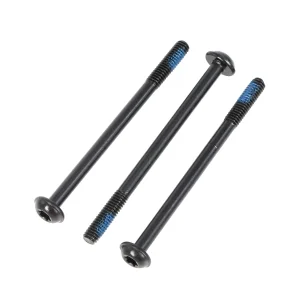
Explore our cold-forged and specialized thread configurations designed to eliminate micro-cracking, balance installation torque, and maximize clamp load across demanding engineering thermoplastics.
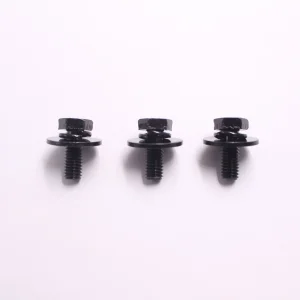
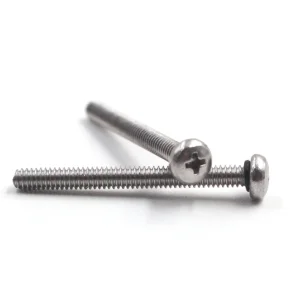
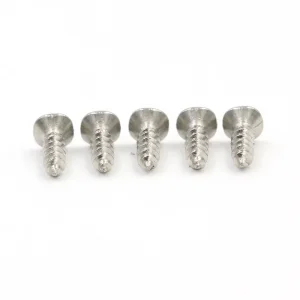
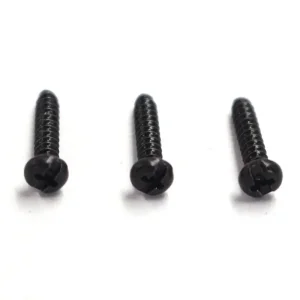
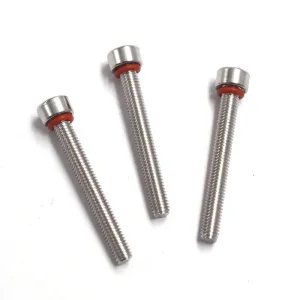
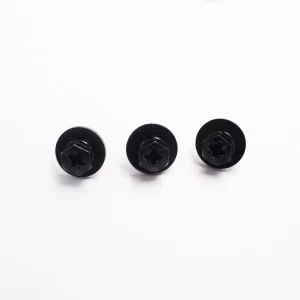
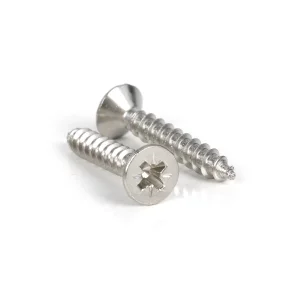
In modern industrial fabrication, mechanical fastening in polymer substrates is undergoing a profound shift. As lightweighting mandates push automotive, aerospace, and medical engineering away from metals toward glass-filled polyamides, PBT, ABS, and polycarbonate, traditional machine screws and brass ultrasonic inserts face severe cost and structural constraints.
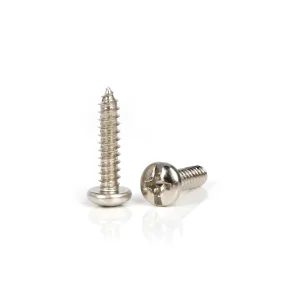
Global OEMs are aggressively designing out heat-set and ultrasonic brass inserts to trim cycle times and eliminate secondary thermal operations. Cold-forged self-tapping screws for plastics directly form high-integrity internal threads into molded boss holes, reducing bill-of-materials costs by 35% to 50% while completely removing post-molding bottlenecks.
Standard 60° thread angles generate extreme radial outward pressure, inducing hoop stresses that rupture polymer bosses. Specialized 30° and 45° asymmetrical thread profiles engineered by China precision factories direct energy axially rather than radially, preventing catastrophic stress-cracking in notch-sensitive resins like PC and PMMA.
Thermoplastics naturally undergo continuous viscoelastic deformation (relaxation) under sustained tensile preloads. Fasteners engineered with trilobular cross-sections or high-pitch flank profiles induce localized plastic flow during drive-in, leaving trapped polymer material that locks against vibration and mitigates longitudinal preload loss.
Selecting the proper fastener geometry is fundamentally dictated by polymer ductility, flexural modulus, and filler concentration. Our Dongguan engineering center formulates thread profiles specific to the rheological behavior of each resin group.
| Fastener Architecture | Operating Principle | Recommended Plastic Substrates | Installation Dynamics | Reusability & Serviceability |
|---|---|---|---|---|
| Thread-Forming (30° Trilobular Flank) | Displaces polymer through localized frictional heating, inducing non-destructive plastic flow. | Ductile thermoplastics: ABS, Polypropylene (PP), Polyamide (PA6/66), Polyethylene (PE), Polyoxymethylene (POM). | Low driving torque, high stripped-to-drive safety window, zero internal chip debris. | High (Allows 5 to 10 repeated insertions into the cold-formed female mating thread). |
| Thread-Cutting (Type 25 / Slotted Flute) | Physically shears and removes resin chips via dedicated cutting slots or serrated flutes. | Brittle, rigid, thermoset resins: Bakelite, Melamine, Diallyl Phthalate, >30% Glass-Filled Phenolics. | Requires chip cavity clearance; strictly controls burst hoop pressure in notch-vulnerable matrices. | Moderate (Thread flanks are cut, prone to wear if re-torqued beyond calibration). |
| Deep-Coarse Flank (Plastite Style) | Wide thread spacing with sharp thread crest to maximize substrate volume between turns. | Low-density polymers, unreinforced polyolefins, structural structural foam, engineered polycarbonates. | Minimizes boss wall bursting strain while significantly elevating axial pull-out force. | Excellent (High shearing cross-section prevents stripping during automated maintenance). |
| Dual-Thread / Hi-Lo Geometry | Alternating high and low thread ridges; high thread forms cut, low thread stabilizes alignment. | Mixed substrate assemblies, composite plastics, plastic-to-thin-metal panel joints. | Prevents wobbling on high-speed robotic assembly spindles; cuts boss cracking risk by 40%. | High (Substantially expands contact friction contact area against vibration). |
From automated electric vehicle assembly plants in Bavaria to smart metering factories in Southeast Asia, our fasteners are engineered to meet localized industrial environments and regulatory constraints.
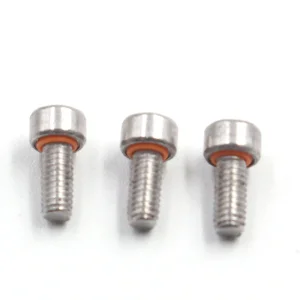
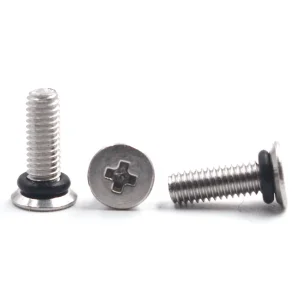
Electric vehicle battery enclosures, smart junction boxes, and inverter covers demand gas-tight, non-conductive, and shock-tolerant fastening. Our sealing self-tapping screws equipped with captive fluorosilicone or EPDM O-rings under the head provide IP67/IP68 ingress protection against battery electrolyte venting and moisture entry.
Micro-drives (M0.8 to M2.0) are essential inside wearable tech, optical transceivers, and handheld smart terminals. With automated pick-and-place robotics operating at millisecond speeds, our precision-machined heads and calibrated Torx or tamper-resistant drive recesses prevent cam-out, eliminating airborne particle debris in cleanrooms.
Smart utility meters and IoT telecommunication gateways deployed in exterior environments require over 15 years of uninterrupted structural integrity without boss relaxation. Custom anti-tamper security recesses (tri-wing, pin-hex, spanner) paired with multi-layer organic zinc-flake coatings guarantee over 1,500 hours of neutral salt spray (ASTM B117) exposure.
How Yu-Huang Electronics (YH Fastener) bridges the gap between raw metallurgy and predictable polymeric clamping through integrated manufacturing science.
We deploy advanced digital twin simulations to model boss hoop stress distributions before cutting cold-heading tooling dies. By tweaking the pitch, thread relief angle, and tip taper dynamically, our engineers ensure maximum flank engagement while keeping the boss stress below 75% of the polymer's ultimate yield point.
For high-throughput robotic assembly lines, a single dimensionally defective screw can jam an automated feed track, incurring thousands of dollars in downtime. YH Fastener equips its Shaoguan, Dongguan, and Wuhan facilities with multi-axis glass-disc laser optical inspection systems, testing head recess depth, shank concentricity, and thread pitch at up to 1,200 parts/min.
Aligning with strict global circular economy directives (RoHS, REACH, and California Proposition 65), our finishing lines offer trivalent zinc (clear, yellow, black), zinc-nickel alloy plating resisting up to 1,000+ hours to red rust, organic Teflon topcoats for friction coefficient stabilization, and ultrasonic cleaning for aerospace clean-pack delivery.
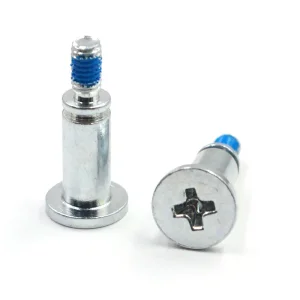
Explore our specialized range of IP67 sealing fasteners, anti-loosening shoulder configurations, and custom machine screws engineered for mission-critical joints.
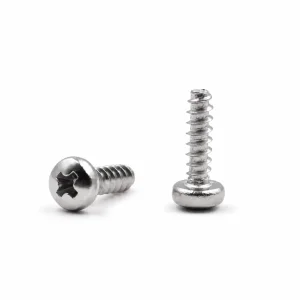
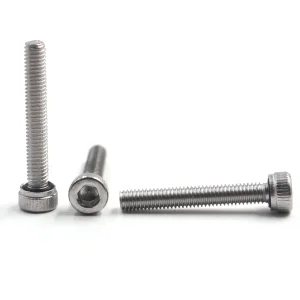
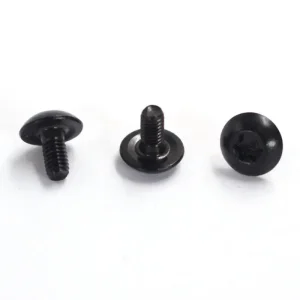
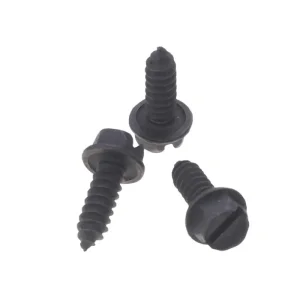
In-depth responses from our senior metallurgical and mechanical application engineers addressing the critical considerations in specifying self-tapping screws for polymeric assemblies.
A correct boss hole design is critical to avoid premature boss burst or thread stripping. The general engineering rule for ductile thermoplastics (ABS, PA, POM) is to size the internal hole diameter equal to approximately 0.80 to 0.85 times the nominal screw diameter (D). For glass-filled or brittle resins (e.g., >30% GF PBT or PC), increase the pilot hole diameter to 0.85 to 0.88 × D to reduce radial hoop stress. Boss wall thickness should typically be 2.0 to 2.5 times the hole diameter, and the engagement depth should be at least 2.0 to 2.5 × D to ensure clamp-load distribution across multiple thread flanks.
The safety window on an automated assembly line is defined by the Stripping Torque (Ts) to Driving Torque (Td) ratio. An acceptable industrial standard requires a minimum ratio of 3:1, though our 30° trilobular geometries consistently achieve ratios of 4:1 or 5:1. We achieve this by optimizing the thread lead angle, minimizing the thread cross-sectional area to lower insertion friction (Td), and applying micro-wax topcoats or fluoropolymer dry lubes that stabilize rotational dynamics without degrading clamping pre-load.
Yes, provided thread-forming (rather than thread-cutting) screws are used. During the primary installation, the screw forms a work-hardened, smooth, burnished internal thread in the plastic. To service the assembly, operators should rotate the screw counter-clockwise under light axial pressure until a faint "click" is felt—confirming the screw has dropped into the original thread start—before re-tightening to torque. Under calibrated conditions, YH thread-forming fasteners support 5 to 10 maintenance cycles without substantial retention loss.
For high-tensile carbon steel self-tapping screws (Class 8.8, 10.9, or case-hardened), electroplating introduces atomic hydrogen risks. YH Fastener strictly adheres to IATF 16949 / ISO 9001 baking standards: fasteners undergo continuous de-embrittlement baking at 200°C–220°C for 4 to 8 hours within 4 hours post-acid pickling and electro-zinc deposition. Furthermore, lots undergo destructive tensile testing, metallographic core/case depth hardness verification, and 48-hour pre-stress sustained load qualification prior to shipping.
Our engineering division accepts 2D formats (DWG, DXF, PDF) and 3D CAD step files (STEP, IGES, SLDPRT). For non-standard custom head designs, specialized security drives, or proprietary thread profiles, our integrated tooling center manufactures cold-heading dies in-house. We provide a complete Design for Manufacturability (DFM) review within 24 hours, prototype samples via rapid tooling in 7 to 10 days, and full-volume production runs in 18 to 25 working days.