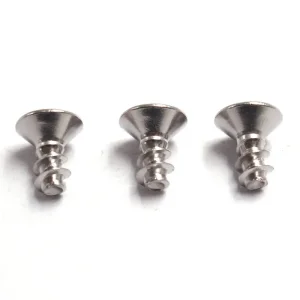
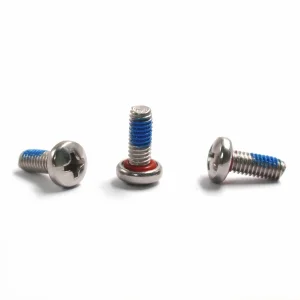
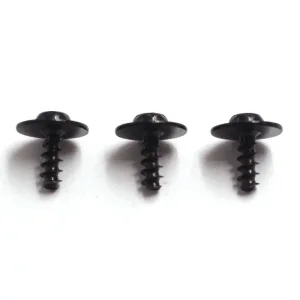
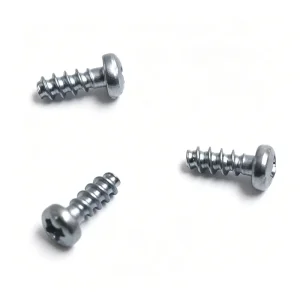
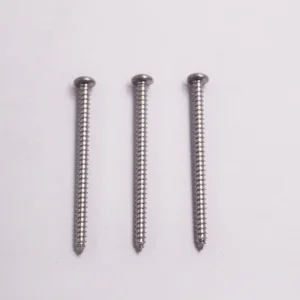
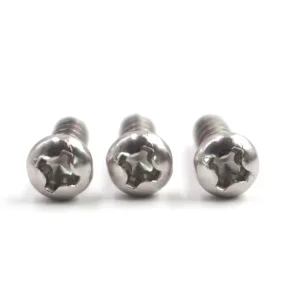
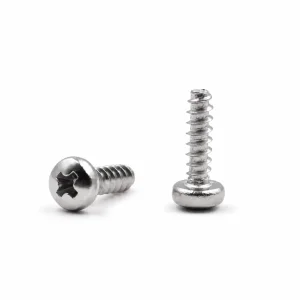
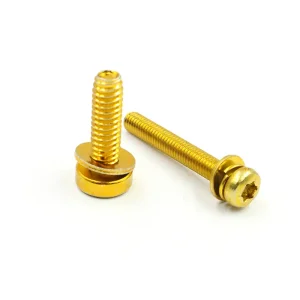
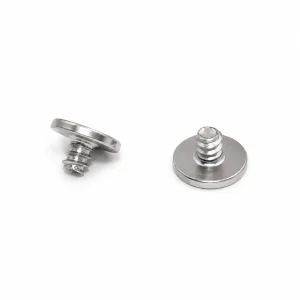
Explore our tier-one certified cold-headed screws, sems assemblies, and specialized self-tapping fasteners. Each solution is manufactured with calibrated thread angles to lower radial hoop stresses in synthetic polymers.
Unlike ductile metals that accommodate localized shear strains, structural polymers exhibit viscoelastic creep, stress cracking, and anisotropic thermal expansion. Choosing the correct custom plastic assembly tapping screw is critical to maintaining clamp force across the product lifecycle.
Standard 60-degree machine screws generate excessive radial vectors when driven into non-ductile resins, causing weld lines and boss wall ruptures. Our specialized 30-degree and 48-degree PT thread profiles reduce radial displacement by up to 45%, converting input torque directly into clean axial clamp load.
Ultrasonic and thermal insertion of brass bushings adds substantial cycle time, capital expenditure, and volatile scrap risk. Custom-engineered self-tapping screws for plastics bite directly into molded bosses, yielding equivalent pull-out strengths while slashing component cost by up to 60%.
Thermoplastics exhibit cold flow over time under mechanical strain. Our thread geometry integrates an optimal pitch-to-depth ratio that maximizes the volume of plastic displaced into thread roots, resisting vibration-induced back-out without liquid chemical threadlockers.
In automated manufacturing environments, a 10 ppm fastener failure rate causes unbudgeted line stoppages, stripped structural bosses, and warranty expenses. Global Tier-1 system builders require strict lot-to-lot traceability, validated metallurgical testing, and predictable delivery windows.
Battery enclosures, battery management system (BMS) trays, and power electronic covers require lightweight, high-integrity polymer-to-metal fastening. Thread-forming fasteners eliminate metal shavings that trigger electrical short circuits in high-voltage battery modules.
Unmanned aerial systems and collaborative factory robots rely on polycarbonate and nylon 66 composites to reduce inertia. Fasteners must deliver extreme pull-out strength in thin-walled bosses while resisting cyclic resonance during high-frequency operation.
Surgical tools, diagnostic enclosures, and drug delivery systems require biocompatible stainless steel (304, 316) self-tapping screws capable of sterile autoclaving and resistant to aggressive hospital disinfectants without degrading housing integrity.
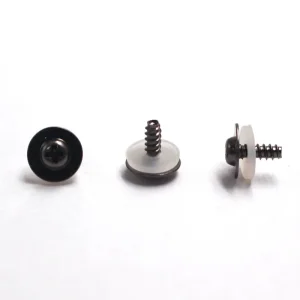
5G micro-base stations and ruggedized outdoor IoT gateways require IP67/IP68 ingress protection. Fasteners engineered with pre-assembled under-head elastomeric washers and nylon patches isolate sensitive electronics from moisture ingress.
A reliable plastic fastening joint requires calculating the critical delta between drive torque (Td) and strip torque (Ts). An optimized thread geometry maintains a minimum 1:3 ratio to enable safe automated assembly tool shut-off.
| Resin Classification | Common Materials | Recommended Thread Profile | Drive/Strip Ratio (Safe Delta) | Boss Design Ratio (OD / Hole Ø) |
|---|---|---|---|---|
| Ductile Thermoplastics | ABS, PP, PE, Flexible PVC | 30° Thread Angle / Wide Pitch (PT) | 1 : 3.8 (Exceptional Safety Window) | 2.00 – 2.20 × Screw Core Ø |
| Rigid / Engineering Resins | PC, PA6/66, POM, PBT | 30° / 48° Asymmetric Profile | 1 : 3.2 (Controlled Torque Shut-off) | 2.25 – 2.50 × Screw Core Ø |
| Filled / Reinforced Resins | PA66-GF30, PEEK-GF, PPS | High-Hardness Case Carbon / 410 SS | 1 : 2.8 (High Friction Window) | 2.40 – 2.80 × Screw Core Ø |
| Brittle / Thermoset Resins | Bakelite, Epoxy, Melamine | Thread-Cutting with Flute (Type 25/F) | 1 : 2.5 (Chip Relief Necessary) | 2.50 – 3.00 × Screw Core Ø |
For self-tapping thread-forming fasteners in standard unreinforced thermoplastics, the optimal pilot hole diameter (Dh) is determined through empirical core displacement calculation:
Where d is nominal outer screw diameter, p is thread pitch, and α is the included flank angle. Utilizing our cold-headed PT profiles with 30-degree flank angles decreases required driving torque, minimizes hoop stress, and eliminates the micro-fissuring common with standard 60-degree fasteners.
Global export operations demand alignment with environmental, safety, and operational standards. Yu-Huang Electronics (Dongguan) Co., Ltd. operates state-of-the-art testing laboratories verified under international regimes.
Every automotive production run undergoes strict Advanced Product Quality Planning (APQP), Production Part Approval Process (PPAP Level 3), statistical process control (Cpk > 1.67), and full IMDS raw material reporting for Tier-1 supply chains.
All surface finishes, zinc chromates, passivations, and anti-loosening coatings are 100% compliant with EU RoHS Directive 2011/65/EU and REACH (EC 1907/2006). Batch-specific XRF screening reports verify absence of restricted hazardous substances.
Hardened carbon steel fasteners receive de-embrittlement baking within 4 hours of electroplating. Salt spray testing spans from 48 hours for standard zinc to over 1,000 hours for specialized zinc-nickel or Ruspert coatings without red rust occurrence.
As polymer engineering advances toward bio-based composites, carbon-fiber reinforced plastics (CFRP), and smart polymer matrices, fastener design adapts to meet higher load concentrations and thermal operating ranges.
Consolidated 30° thread profiles featuring optimized pitch progression. Prevents stripping and minimizes stress concentration in automated high-speed driver environments.
Application of dry-film fluoropolymer and organo-mineral topcoats that stabilize drive torque coefficients, mitigating erratic stick-slip behaviors during robotic feeding.
Patented progressive double-angle thread profiles designed to avoid delamination when cutting through abrasive carbon and glass fiber strands in structural composites.
Traceable batch serialization with micro-etched DataMatrix codes for critical aviation and medical polymer assemblies, linking every fastener to raw wire heat lots.
Addressing structural, tribological, and procurement considerations when transitioning to custom-manufactured thread-forming screws for plastics.
Standard sheet metal screws feature wide 60-degree flank angles that exert high radial hoop forces on thermoplastic bosses. This often produces micro-fractures, boss bulging, or stripped threads. Custom PT-style fasteners with acute 30-degree profiles displace polymer smoothly into thread roots, significantly improving pull-out resistance and strip-to-drive torque safety ratios.
We perform systematic torque testing using your molded plastic boss specimens. By measuring driving torque (Td) and failure stripping torque (Ts), we design the fastener to achieve a minimum 1:3 ratio. Assembly tools are typically set to Td + 0.5 × (Ts - Td), protecting bosses from stripping while ensuring sufficient clamp force to resist service vibrations.
For corrosion protection in outdoor plastic assemblies (such as solar junction boxes and surveillance housings), we manufacture fasteners from austenitic Stainless Steel 304 or 316. Alternatively, hardened alloy carbon steel can be treated with multi-layer zinc-nickel alloy plating and organic passivations, providing over 1,000 hours of neutral salt spray resistance per ASTM B117.
Yes. Because thread-forming screws plastically deform rather than cut away resin, the formed female thread remains intact. When reassembling, turning the screw backward slightly until it drops into the existing thread track preserves the joint, maintaining high pull-out retention across multiple service cycles.
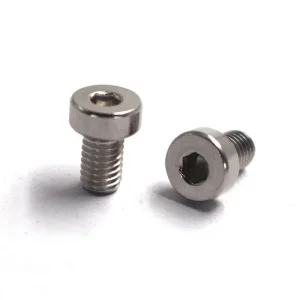
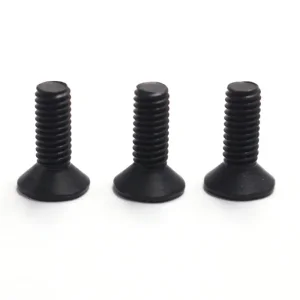
Explore our full line of industrial fasteners, including ultra-thin heads, anti-loosening PT screws, corrosion-resistant brass parts, and standardized machine bolts for critical production programs.